
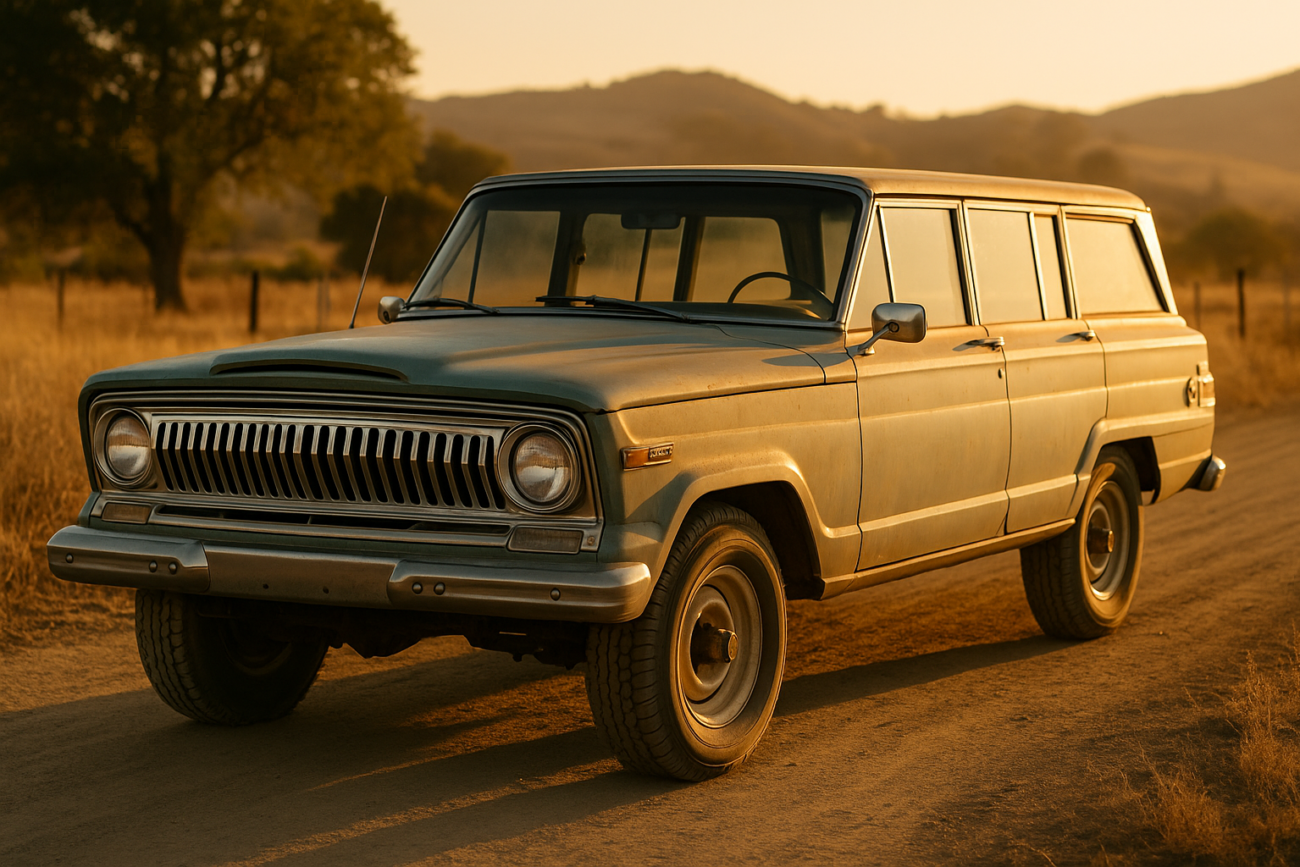
Overview: A Rare Snapshot of Where the SUV Began
The Jeep Wagoneer wasn’t just an old truck with a wagon body bolted on — it was the vehicle that invented the modern SUV formula. The Jeep Wagoneer is a luxury 4×4 produced and marketed under the Jeep brand from the 1963 to 1991 model years, introduced as the replacement for the Jeep Station Wagon, and it was the first Jeep model line completely distinct from the Jeep CJ. Designed by a team led by industrial designer Brooks Stevens, the Wagoneer shared its Jeep SJ chassis with the Jeep Gladiator full-size pickup truck, and was also offered as a three-door wagon and a two-door panel truck alongside the five-door wagon before the lineup was simplified to five-door only after 1968.
What made it revolutionary wasn’t off-road capability alone — plenty of trucks could do that. Compared with offerings from GM, Ford, International Harvester, Toyota, Nissan and Land Rover, which were producing utilitarian work-oriented vehicles with spartan truck-like interiors, the Wagoneer’s luxury set it apart. The revolutionary Wagoneer SJ platform included an advanced overhead cam straight-six engine, and offered features unheard of at the time in any other mainstream 4WD vehicle, such as independent front suspension, power steering, automatic transmission, a factory radio, and optional air conditioning. A 1966 example represents this original concept in its purest, least-diluted form — before the woodgrain, before the “pig-nose” grille update, before Chrysler’s ownership era.
1966 in Context: A Year of Quiet But Important Changes
1966 sits right at a hinge point in Wagoneer history, and it matters enormously for what’s actually bolted to the frame of any given truck. The higher-content Super Wagoneer was introduced for 1966, upgrading the model line with features from higher-priced sedans, and it was identified by a new, more modern-looking full-width grille, initially featuring a higher-performance 270 hp version of the AMC V8 fitted with a four-barrel carburetor. That’s the halo trim — the truck in this listing, described simply as a base-spec 4×4 with a 3-speed manual, is not that.
More importantly for a project buyer: late-year 1965 Wagoneers and Gladiators were available with the 250 hp 327 cubic-inch AMC V8 engine, and the Tornado overhead-cam six was replaced by American Motors’ 232 cubic-inch OHV inline-six around the same time. Also around this point, the independent front suspension option — while positively reviewed by the press — was dropped from production for 4WD models in 1965 because it wasn’t popular with buyers of the truck-duty 4x4s. The practical upshot: a 1966 4×4 Wagoneer should have a conventional solid front axle, not the fussier IFS from the earliest trucks — one less thing to worry about.
The engine question is murkier and is the single biggest thing to nail down on this particular truck before bidding. Model-year changeovers in this era weren’t always clean, and “1966” doesn’t automatically mean the new AMC six was under the hood on day one of production — nor does 60 years of ownership guarantee the original engine is still there at all.
The Tornado 230: Why It Matters If This Truck Still Has One
If this project truck turns out to carry the earlier Kaiser-built “Tornado” OHC 230 six rather than the AMC 232, buyers need to go in with clear eyes. It was genuinely innovative for Detroit in 1962 — the aluminum-head Tornado had a single, centrally located, chain-driven camshaft operating stamped-steel rocker arms, with both the intake and exhaust valves for each cylinder actuated by a single cam lobe — but innovation didn’t equal durability. The Tornado suffered a number of problems, including excessive oil consumption, possibly due to the company’s meager development resources, and multiple independent sources agree on this reputation. Enthusiasts on the International Full Size Jeep Association forum describe the engine’s real-world quirks bluntly: it involves frequent valve adjustments, new timing chains, and constant oil leaks from the timing cover, with a bad rigid motor mount design that trashes the timing cover gasket, and the critical advice is to check oil level often — low oil starves the top end first and eats the cam. A separate thread of enthusiasts on BangShift’s forums independently corroborates the same weak points: the Tornado is known for excessive oil consumption and cam lobe/bearing wear and failure, and it was replaced by the AMC 232 for this very reason. Three independent sources landing on the same failure mode — oil-starved cam and valvetrain wear tied to a maintenance-intensive design — is enough to call this a genuine, characteristic weakness of the engine rather than forum noise.
The good news, if it applies here: by the time the 232 replaced it, testers considered the newer six a clear upgrade. According to the automotive press, the new engine was smooth, powerful, reliable, and easily maintained, though the most likely reason it was offered was that it was less expensive to build. If this truck already received that running gear from the factory (or a prior owner has already swapped a 232 or the 327 V8 in), a lot of the Tornado-specific risk simply goes away.
Drivetrain: 3-Speed Manual, Dana 20 Transfer Case, Solid Front Axle
The listing’s “3-speed” callout points to a column-shifted manual gearbox, the entry-level box paired with the six-cylinder engines of this era rather than the V8. Behind it sits Jeep’s venerable Dana Spicer Model 20 transfer case, a genuinely good piece of engineering for the period. It’s compact, light, durable, simple to build and capable, featuring dual modes (2WD and 4WD) and dual ranges, with the high range in direct 1:1 drive and the low range at a 2.0:1 reduction. Parts support for it remains strong decades later through specialists and reproduction suppliers, so wear or a leaking case seal isn’t a dealbreaker. Novak also notes that some remote “J” shift versions of the Dana 20 are problematic and present challenges if the truck is ever adapted to a different transmission — worth knowing if a drivetrain rebuild or swap is in the plan.
Anyone considering a later engine swap should also know that bellhousing patterns changed around this exact model year, which affects parts interchange. The bellhousing bolt pattern for the old AMC 196 straight-six is the same as for the later 199 and 232 sixes, but AMC’s 1956-to-1966 V8s used a different bellhousing bolt pattern, and when AMC discontinued that first V8 design after 1966, the bellhousing pattern changed again, with all 1966-and-up V8 bellhousing patterns sharing a common bolt pattern from that point forward. That’s a useful detail for anyone planning to modernize the drivetrain down the road.
Body, Frame, and Rust: The Real Money Pit
On a 60-year-old truck-based wagon, rust — not the drivetrain — is usually what determines whether a project is viable or a parts donor. General vintage-Jeep inspection guidance, which applies directly to the SJ Wagoneer’s body-on-frame construction, is blunt about where to look. The floor pans, rocker panels, and frame are particularly prone to rust; buyers should remove floor mats and peel back carpeting to check for rust holes in the floor and sills, then crawl underneath and give everything a good poke with a screwdriver as a test for frame rust, since surface rust can be sanded and repainted but a frame that crumbles when prodded means walking away. Also check for previous frame repair — freshly painted or welded segments are an obvious sign that work has already been done.
If the rocker panels have been covered with rock sliders, ask the seller to remove them so you can make sure they’re not hiding severe rust damage, and inspect the body mounts carefully — they rust easily, and rot at the mounts can mean a difficult repair. Water and vibration also take a toll on steering and suspension: crawl underneath and inspect the ball joints, tie-rod ends, spring bushings, and mount points, and check the various universal joints in the axles and driveshafts for excessive play.
The good news for restorers: body-panel reproduction support for this platform is unusually good for a 60-year-old truck. Suppliers offer a wide selection of Wagoneer floor pans, rocker panels, and trunk extensions covering the classic SJ generation, noting that the 4WD Wagoneer saw only minor mechanical changes across its 28-plus-year production run. Front floor pans, cab corners, quarters, and door skins are all reproduced by multiple restoration-panel houses, so rust repair on this platform is a known, budgetable quantity rather than a fabrication nightmare.
Pre-Purchase Inspection Checklist
- Pull carpet and floor mats to check floor pans and sills for rust-through; probe with a screwdriver, not just a visual look.
- Get underneath and check the full frame rails for rust perforation and any signs of prior welding or repair (fresh paint on the frame is a red flag, not a reassurance).
- Inspect body mounts specifically — they rust from the inside out and are a difficult, labor-intensive repair if gone.
- Identify the actual engine present (Tornado 230 OHC six vs. AMC 232 OHV six vs. 327 V8) — this changes the entire risk and cost profile of the truck.
- If it’s the Tornado six: check oil consumption, listen for valvetrain clatter, check for timing-cover oil leaks, and budget for a head/valvetrain refresh as a near-term expense rather than a maybe.
- Confirm the transfer case shifts cleanly between 2WD/4WD and Hi/Lo, and check the Dana 20 for leaks at the output seals.
- Check ball joints, tie-rod ends, spring bushings, and U-joints for play — common wear items on any solid-axle Jeep of this vintage.
- Verify title status, VIN plate legibility, and that the drivetrain numbers/casting dates are period-plausible for a 1966 build.
- Because this is billed as single-family-owned, ask for any paperwork trail (original title, past registrations, service records) — provenance like this is a genuine value driver at auction, but only if it’s documented.
Which Spec to Seek Out (and Which to Avoid)
For collectors chasing the most desirable 1966 Wagoneer, the answer is the Super Wagoneer, introduced this exact year with its four-barrel 327 V8 and upscale trim, as noted above — it’s the halo model and priced accordingly when it surfaces at auction. A base-trim 4×4 with a 3-speed manual, like the truck in this listing, sits at the opposite end of the spectrum: it’s the honest, working-class version of the platform. That’s not a knock — for buyers who want the original SJ concept without the premium attached to Super Wagoneer trim, and who value mechanical simplicity (a 3-speed manual has far fewer failure points than an aging automatic), this is arguably the more sensible entry point into first-generation Wagoneer ownership, provided the rust and engine questions check out.
Because the independent front suspension option was dropped for 4×4 models by 1965, there’s no IFS-vs-solid-axle decision to make on a genuine 1966 4×4 — it should have the solid front axle, which is the simpler and generally more durable choice for a truck that’s likely to see real off-pavement use.
Values and Market Reality
Pricing data for base-trim, project-condition 1966 Wagoneers is thin, and buyers should treat any number here as a starting point for further research rather than gospel. One concrete data point: a 1966 Jeep Wagoneer crossed the block at a Mecum auction in July 2019 with a highest bid of $7,000 that did not meet reserve. A broader market benchmark tracked for the “Wagoneer – Base Model – SJ” segment spanning the full 1963–1984 production run sits meaningfully higher, but that figure covers the entire generation across a huge range of condition, originality, and drivetrain combinations — it is not a reliable stand-in for what a rough, project-grade, no-reserve 3-speed truck will actually bring. First-generation (1963–’65-into-’66) trucks with documented single-family ownership and a clean title carry a real premium over anonymous, multiple-owner project trucks, but exactly how much premium is something the editor should confirm against recent, condition-matched comparables before publishing a number.
Ownership Costs and Parts Availability
The reassuring part of owning an early Wagoneer is that body and structural parts support is genuinely good — floor pans, rockers, quarter panels, and wheel arches are reproduced by more than one restoration-panel supplier, so rust repair is a solved problem in terms of sourcing, if not in terms of labor hours. Transfer case and driveline hard parts for the Dana 20 are likewise well supported through both OEM-style reproduction suppliers and Jeep drivetrain specialists. The wildcard is the Tornado engine, if this truck has one: it was a low-volume, short-lived design discontinued from civilian use six decades ago, and while specialty vendors still sell rebuild parts and guidance for it, buyers should expect longer sourcing times and higher costs for internals like camshafts and heads than they would for the far more common later AMC sixes and V8s.
Verdict
A single-family-owned 1966 Jeep Wagoneer 4×4 project with a 3-speed manual is a genuinely interesting proposition — this is the truck that invented the luxury 4×4 concept, still close to its original form, before the woodgrain and badge-engineering years. But “project” and “no reserve” both signal unknown work ahead. The deciding factors aren’t cosmetic: they’re what’s actually under the hood (Tornado six vs. the improved AMC 232 vs. a V8), and how far the rust has progressed in the floors, frame, and body mounts. Buyers who do their homework on those two questions — and who go in expecting real mechanical and rust-repair spending regardless of the answer — are the right audience for this truck. Buyers looking for a turnkey driver should look at a later, more sorted SJ instead.
