
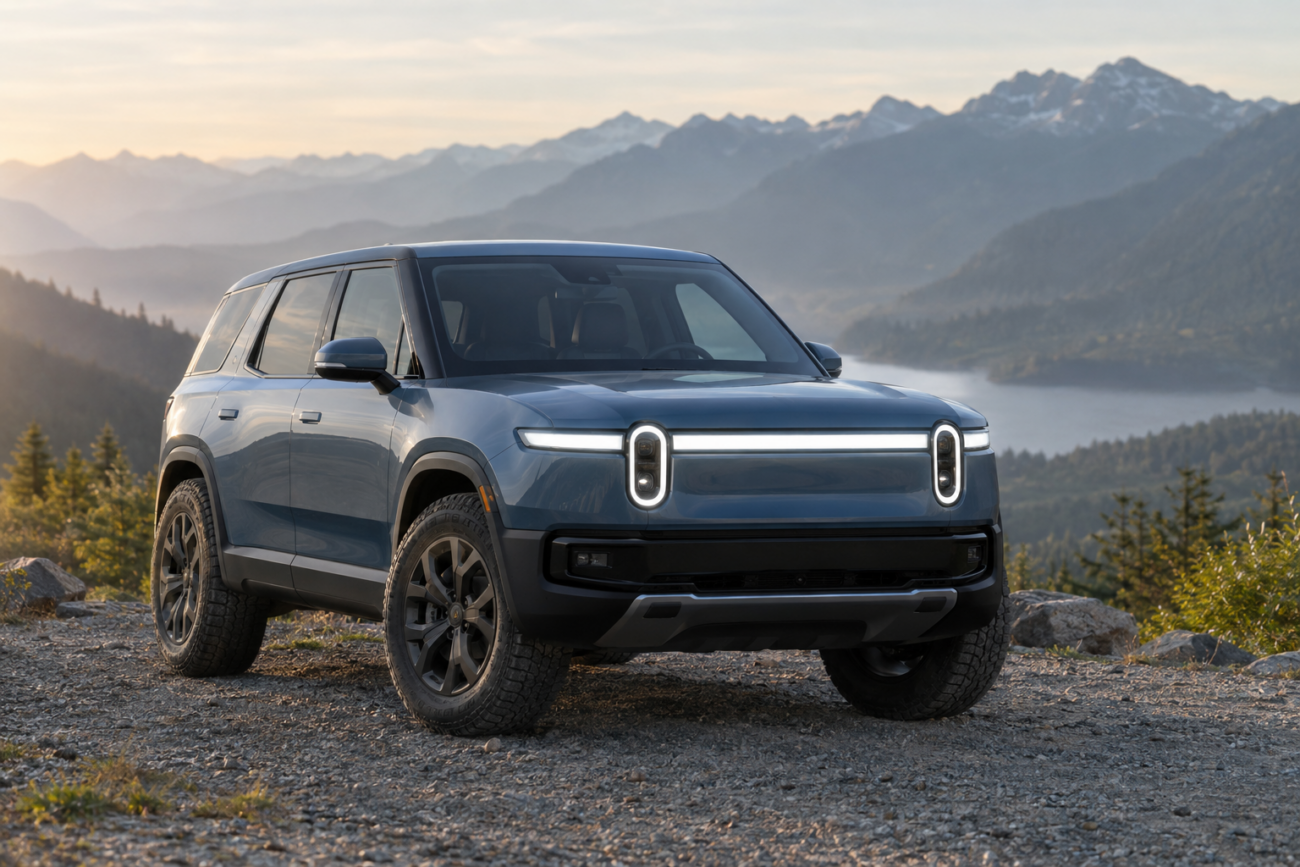
With impressive efficiency, dual-motor performance, advanced technology, and a more attainable price, the Rivian R2 could become one of the most important electric SUVs to enter the market.
Rivian has never struggled to build interesting vehicles. The R1T pickup and R1S SUV established the American automaker as a legitimate competitor in the premium electric vehicle market, combining impressive off-road capability, distinctive styling, and sophisticated electric drivetrains. What Rivian has struggled with, however, is affordability.
With prices reaching well beyond $80,000, the company’s flagship vehicles have largely appealed to buyers willing to spend luxury-vehicle money on an electric adventure vehicle.
The 2027 Rivian R2 represents a fundamental change in that approach.
Designed as a smaller, more accessible alternative to the R1S, the R2 brings Rivian’s design philosophy and technology into the competitive midsize SUV segment. The Performance model, priced below $60,000 in the configuration discussed here, offers dual electric motors, substantial battery capacity, advanced driver assistance, and a surprisingly practical interior.
More importantly, the R2 arrives at a time when electric vehicle buyers are becoming increasingly selective. Range, efficiency, charging infrastructure, interior quality, and overall value matter more than novelty.
The R2 needs to be more than an affordable Rivian. It needs to be a genuinely competitive vehicle.
A Smaller Rivian With Familiar Design DNA
At first glance, there’s little mistaking the R2 for anything other than a Rivian.
The company’s signature vertical, stadium-shaped headlights remain prominent, accompanied by full-width LED lighting elements that give the SUV its distinctive appearance. The upright body, squared-off proportions, and relatively short overhangs reinforce its adventure-oriented character.
Unlike the larger R1S, the R2 occupies a more manageable footprint. This makes it better suited to suburban garages, crowded parking lots, and urban driving without abandoning the rugged styling that has become central to Rivian’s identity.
The smaller dimensions also help distinguish the R2 from the increasingly large SUVs dominating American roads.
Rather than attempting to maximize vehicle size, Rivian has focused on packaging efficiency, creating a vehicle that feels spacious inside without requiring full-size SUV exterior dimensions.
The result is an attractive balance between utility and maneuverability.
Dual-Motor Performance Meets Improved Efficiency
Electric vehicles are frequently judged by acceleration figures, but efficiency may ultimately be the R2’s more important achievement.
The R2 Performance uses a dual-motor electric drivetrain, providing immediate torque delivery and responsive acceleration. The electric powertrain delivers smooth performance during highway merging, passing, and stop-and-go traffic.
However, the most interesting numbers come from real-world energy consumption.
During a week of driving covering 236.8 miles, the R2 Performance achieved an average efficiency of 3.24 miles per kilowatt-hour (mi/kWh).
That’s a considerable improvement over the approximately 1.85 mi/kWh recorded during previous testing of the larger Rivian R1S.
Real-World Efficiency Results
| Measurement | Observed Result |
|---|---|
| Distance driven | 236.8 miles |
| Average efficiency | 3.24 mi/kWh |
| Highway efficiency | Up to 3.68 mi/kWh |
| Short urban driving | Up to 3.59 mi/kWh |
| Battery capacity | 87.9 kWh |
| Drivetrain | Dual-motor electric |
The difference is significant.
At an average of 3.24 mi/kWh, the R2 consumes approximately 30.9 kWh of electricity per 100 miles. By comparison, a vehicle averaging 1.85 mi/kWh requires roughly 54.1 kWh to cover the same distance.
That represents approximately 43% less energy consumed per mile under the respective observed conditions.
While the comparison involves different vehicles and driving conditions, it illustrates the progress Rivian has made toward building a more efficient electric SUV.
Using the reported 87.9 kWh battery capacity, the observed average efficiency mathematically corresponds to approximately 285 miles of range. This is an illustrative calculation using total stated battery capacity, not a verified usable-battery or EPA range figure.
For buyers concerned about electricity consumption, charging frequency, and long-distance usability, the R2’s efficiency is a major selling point.
Charging: Native NACS Support Is a Major Advantage
Charging convenience remains one of the most important considerations for prospective electric vehicle owners.
The R2 addresses this with a native North American Charging Standard (NACS) charging port, providing compatibility with supported Tesla Supercharger locations.
This eliminates the need for a separate adapter when using compatible NACS charging equipment.
For CCS fast-charging stations, an adapter provides additional charging flexibility.
The combination gives owners access to multiple charging networks, an important advantage for road trips and areas where public charging infrastructure remains inconsistent.
Can the Rivian R2 Charge From a Regular Household Outlet?
Yes, although charging speed is limited.
During testing with a standard 120-volt household outlet, the R2 recovered approximately 29 miles of driving range over 8.6 hours.
That works out to approximately 3.37 miles of added range per hour.
For someone driving 20 to 30 miles per day, overnight Level 1 charging could potentially replenish much of their daily consumption, depending on conditions.
However, a dedicated 240-volt Level 2 home charger would be considerably more practical for owners with longer commutes or frequent road trips.
The important takeaway is that the R2 offers charging flexibility without requiring specialized equipment for every situation.
Interior Space: Practicality Without the Full-Size Footprint
One of the R2’s strongest attributes is its interior packaging.
Despite being smaller than the R1S, the cabin offers generous headroom and legroom for both front and rear passengers.
The relatively upright roofline contributes to a spacious interior, while the large windows and panoramic glass roof create an open, airy atmosphere.
Cargo capacity is equally important.
With the rear seats upright, the R2 provides approximately 28.7 cubic feet of rear cargo space.
The cargo area is tall and relatively square, making it more useful than the raw volume figure might suggest.
For example, a compact JackRabbit OG2 electric bicycle can fit upright without folding, demonstrating the practical height available behind the rear seats.
That kind of packaging matters to owners transporting recreational equipment, tools, camping gear, or everyday household items.
The Front Trunk Adds Useful Storage
The R2 also includes a front trunk, commonly referred to as a frunk.
With no conventional internal combustion engine occupying the space beneath the hood, Rivian uses the available area for additional storage.
The compartment is large enough to accommodate groceries, smaller bags, and miscellaneous equipment.
For families and outdoor enthusiasts, the combination of front and rear cargo areas provides flexibility that traditional gasoline-powered crossovers cannot always match.
Autonomy Plus: Advanced Driver Assistance That Feels Refined
Driver assistance technology has become a major competitive differentiator among modern electric vehicles.
Rivian’s Autonomy Plus system combines high-resolution cameras, radar sensors, and software to assist with highway driving.
The system manages lane centering, following distance, acceleration, and braking under supported conditions.
What makes it particularly noteworthy is the smoothness of its operation.
Rather than making abrupt steering corrections or reacting aggressively to changes in traffic speed, the R2 delivers relatively natural responses.
Automatic Lane Changes
One of Autonomy Plus’s most useful functions is assisted lane changing.
With the system active, engaging the turn signal allows the vehicle to evaluate surrounding traffic and execute a lane change when conditions permit.
Once completed, the turn signal automatically cancels.
The R2’s high-dynamic-range camera system also provides clear exterior views in low-light conditions, helping improve visibility through the vehicle’s camera interfaces.
Autonomy Plus is included with the Launch Edition package described here. Outside that package, the stated one-time activation cost is $2,500.
For drivers regularly covering long highway distances, the system offers meaningful convenience.
It is important to recognize, however, that Autonomy Plus is a driver-assistance system rather than a replacement for an attentive driver.
Dynamic Matrix LED Headlights: Technology With Real Benefits
Not all automotive technology is equally useful.
Some features exist primarily to impress passengers or add another specification to a marketing brochure. Others provide genuine improvements to the driving experience.
The R2’s available Dynamic Matrix LED headlights fall into the latter category.
Conventional automatic high-beam systems generally operate by switching between high and low beams.
Matrix lighting takes a more sophisticated approach.
The system selectively adjusts individual portions of the headlight beam, reducing illumination around approaching vehicles while maintaining stronger lighting in other areas.
This allows more of the roadway to remain illuminated without unnecessarily dazzling other drivers.
The effect is particularly noticeable on dark, winding roads where maintaining visibility is essential.
According to the trim information provided, Dynamic Matrix LED headlights are available on Performance and Premium configurations, while the Standard trim does not offer the feature.
For buyers who frequently drive at night, this technology deserves serious consideration.
Elevation Audio: Rivian Takes Sound Quality In-House
Rather than relying on a familiar premium audio brand, Rivian has developed its own Elevation Audio system.
The system delivers a balanced listening experience with strong bass response, clear vocals, and immersive surround sound.
Dolby Atmos compatibility adds spatial audio capabilities when supported content is available.
The R2’s relatively quiet cabin helps the system perform particularly well.
Electric drivetrains eliminate much of the engine noise associated with conventional vehicles, although tire and wind noise remain important factors at highway speeds.
The R2’s sound insulation helps maintain a refined interior environment.
An animated equalizer visualization is also available through the infotainment system, although some drivers may find the movement distracting.
Fortunately, it can be disabled.
A Power-Lowering Rear Window Adds Unexpected Versatility
One of the R2’s most interesting features has nothing to do with electric motors, battery technology, or software.
It’s the rear window.
Unlike most modern SUVs, the R2 features power-lowering rear glass that retracts into the tailgate.
This creates an open-air experience when combined with the side windows, allowing additional airflow through the cabin.
It’s a simple feature, but one that adds genuine versatility.
For outdoor activities, camping trips, and warm-weather driving, the retractable glass gives the R2 a distinctive advantage over many competitors.
It’s also an example of Rivian incorporating practical, adventure-oriented features rather than focusing exclusively on digital technology.
Infotainment: Rivian Continues to Prioritize Software
Modern vehicles increasingly depend on software for functions that were once controlled through physical buttons and switches.
The R2 follows that trend with a large central touchscreen serving as the primary interface for vehicle settings, navigation, media, and climate controls.
The system is responsive, with quick transitions and logically organized menus.
Rivian’s interface compares favorably with those found in vehicles from Tesla, Polestar, and Volvo.
The emphasis is on a clean presentation, minimal visual clutter, and straightforward access to vehicle functions.
Integrated Drive Cam Eliminates the Need for Additional Hardware
One particularly useful software feature is Rivian’s integrated Drive Cam system.
The vehicle can record footage using its existing exterior cameras, storing video on a compatible USB-C storage device.
This eliminates the need for a separate windshield-mounted dash camera, additional power cables, or aftermarket installation.
For drivers who regularly use dash cameras for accident documentation or recording road trips, the integrated system is a practical addition.
Haptic Halo Wheels: Clever Engineering With Room for Improvement
Not every R2 innovation is an immediate success.
The steering wheel features Haptic Halo Wheels, multifunction controls that use scrolling inputs and tactile feedback instead of conventional directional buttons.
These controls can adjust audio volume, change tracks, and manage certain vehicle settings, including mirror and steering column adjustments.
The haptic feedback is designed to replicate the sensation of mechanical clicks.
However, the controls can be overly sensitive.
Accidental contact during normal steering maneuvers may trigger unintended adjustments, particularly to the audio volume.
While the concept reduces the number of physical switches, it also introduces a learning curve.
Adjustable sensitivity or a programmable dead zone would improve the experience.
This is an area where a future software update could potentially address a hardware-related usability concern.
The Panoramic Glass Roof Has One Notable Drawback
The R2’s panoramic glass roof makes the interior feel larger and provides an unobstructed view of the sky.
UV protection helps reduce exposure to sunlight, but the roof lacks an integrated interior shade or electrochromic dimming.
That omission creates some practical limitations.
During bright conditions, occupants have limited control over incoming light.
Privacy is another consideration, particularly for owners who plan to use the R2 for camping or sleeping inside the vehicle.
A physical shade would provide additional flexibility without compromising the overall design.
For a vehicle marketed toward outdoor enthusiasts, the absence of this feature is somewhat surprising.
Gear Selection and Cruise Control: Too Much Responsibility for One Stalk?
The R2 also continues Rivian’s approach of combining multiple vehicle functions into a single steering column stalk.
The right-side stalk handles gear selection along with certain driver assistance controls.
Although the arrangement reduces physical clutter, it can make operation less intuitive.
Gear selection and cruise control are fundamentally different functions, and placing them on the same control requires drivers to become familiar with multiple input methods.
Dedicated cruise control buttons or a separate control arrangement would provide clearer functional separation.
This may become less noticeable over time, but it remains an ergonomic compromise worth considering.
Rivian R2 Performance vs. Standard: Which Makes More Sense?
The Performance trim offers the strongest combination of power, technology, and premium equipment in the R2 lineup described here.
Its dual-motor drivetrain, advanced lighting, premium audio, and Autonomy Plus availability create a compelling package.
However, the upcoming Standard model may ultimately be more important to Rivian’s long-term success.
With a targeted starting price of approximately $45,000, the Standard trim aims to bring Rivian ownership to a substantially broader audience.
Naturally, a lower price means compromises.
The Standard model is expected to offer a simpler drivetrain configuration and fewer premium features.
For many buyers, however, maximum acceleration and advanced lighting technology may be less important than range, reliability, cargo space, and purchase price.
If Rivian can preserve the R2’s fundamental strengths at the lower price point, the Standard model could become the company’s most influential vehicle.
Final Verdict: Rivian’s Most Important Vehicle Yet?
The Rivian R2 Performance represents a significant step forward for the American electric vehicle manufacturer.
Its smaller dimensions make it more manageable than the R1S, while the interior remains spacious enough for everyday family use and recreational activities.
The dual-motor drivetrain delivers the responsiveness expected from a modern electric vehicle, but the efficiency improvements are arguably more impressive.
Real-world consumption averaging 3.24 mi/kWh demonstrates how much more efficiently Rivian can package its technology in a smaller platform.
Charging flexibility, native NACS compatibility, useful cargo space, and advanced driver assistance further strengthen the vehicle’s appeal.
There are shortcomings.
The haptic steering wheel controls need refinement, the panoramic roof would benefit from an integrated shade, and the multifunction steering column stalk isn’t as intuitive as dedicated controls.
None of these issues fundamentally undermines the vehicle, but they illustrate where Rivian still has opportunities to improve.
The larger question is whether the R2 can deliver the same appeal at its planned $45,000 entry-level price.
If it can, Rivian may have something far more important than another premium electric SUV.
The R2 could become the vehicle that transforms Rivian from a niche adventure-oriented EV brand into a serious competitor in the mainstream automotive market.
For buyers interested in electric performance, practical SUV utility, and technology that serves a genuine purpose, the Rivian R2 is worth watching closely.
