
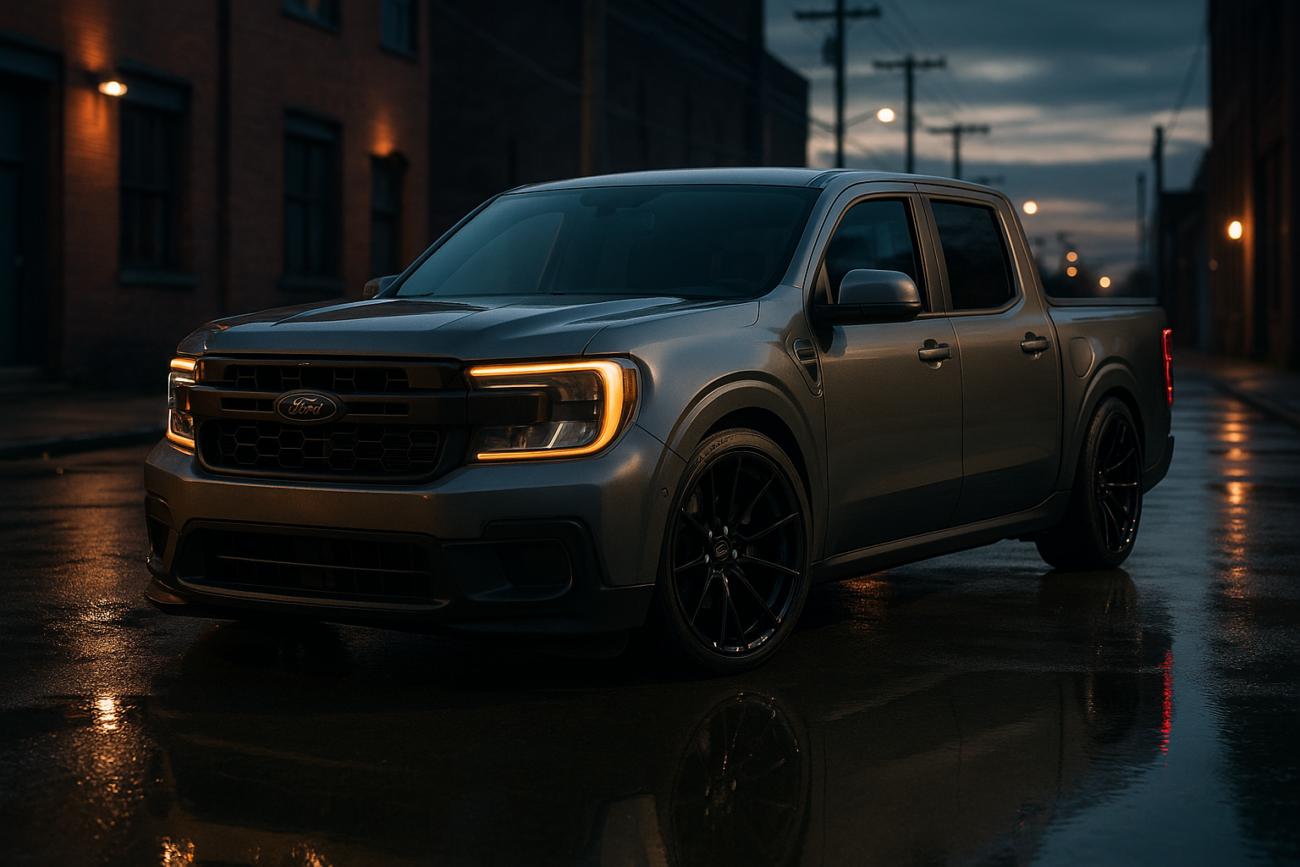
Why the Maverick Still Matters
Ford’s compact unibody pickup arrived for 2022 as a back-to-basics alternative to bloated, expensive midsize trucks, and for 2025 it gets its first real mid-cycle refresh rather than a clean-sheet redesign. The Ford Maverick debuted for the 2022 model year, and is mere months into its first mid-cycle refresh that arrived for the 2025 model year. If you’re cross-shopping a brand-new 2025 or a lightly used 2022-2024 example, the shopping considerations overlap heavily, since most of the mechanical hardware, known weak points, and recall history carry across model years with only software and some equipment changes.
What’s New for 2025
The 2025 model year brings a cosmetic refresh plus two genuinely significant powertrain and lineup changes. The exterior gets a refresh, including revised grille, front fascia and dark-appearance headlamps, and inside, the appearance of the instrument panel, center display and audio and climate controls is revised. An 8-inch digital cluster display and a larger 13.2-inch center-display are standard across all models, and a 360-degree camera system is available.
The bigger news is under the skin. For 2025, the Ford Maverick gets a visual refresh, new cabin tech, and, at last, all-wheel drive capability with its hybrid drivetrain. Previously you had to choose hybrid-and-FWD or EcoBoost-and-AWD; now you can combine hybrid power with AWD. Hybrid is now available with AWD and an EPA rating of 40 mpg City, and the hybrid AWD also offers an optional 4K Tow package.
Ford also reshuffled the trim ladder. The off-road Tremor, previously an options package, is now its own standalone trim, and Ford added an entirely new model aimed at street performance. Ford introduces a new model called the Maverick Lobo, a performance street truck version of Maverick, which comes with the new MPC 2.0-liter EcoBoost engine, advanced 4-wheel drive with a 7-speed quick shift transmission, and upgrades such as a twin-clutch rear drive unit, enhanced brakes, performance-tuned steering, on-road tuned suspension, lowered ride height and specially tuned springs and shocks. There’s even a dedicated drive mode for it: inspired by autocross, there’s also a new Lobo drive mode meant for closed courses, which improves cornering performance, grip, and stability.
Trims and Pricing
For 2025 the Maverick lineup runs five-deep: XL, XLT, Lobo, Lariat and Tremor. The 2025 Ford Maverick comes in five trims: XL, XLT, Lobo, Lariat and Tremor. Rough starting points (destination included, per Edmunds and U.S. News):
- XL – The 2025 Maverick starts at $26,995 for the base XL trim. It comes standard with cloth upholstery, a 13.2-inch touch screen, Ford’s Flexbed in-bed storage system and forward automatic emergency braking.
- XLT – The XLT is priced from $29,495 and gets 17-inch alloy wheels, proximity keyless entry and a trailer hitch receiver.
- Lobo – New for 2025, the street-performance-enhanced Lobo (base MSRP: $35,255) comes with a lowered suspension, 19-inch alloy wheels, synthetic leather upholstery, unique styling elements and upgraded steering, suspension and brakes.
- Lariat – The upmarket Lariat trim starts at $37,290 and gets a premium B&O stereo, dual-zone automatic climate control, a surround-view camera system and blind-spot monitoring.
- Tremor – priced above Lariat territory in most configurations; confirm current figure with your dealer, as exact MSRP wasn’t consistent across the sources we pulled.
Overall, the 2025 Ford Maverick’s price range runs from roughly $28,145 to $41,425 depending on trim, engine, and options, and final assembly happens in Mexico. Both Edmunds and U.S. News independently land on the XLT as the sweet-spot trim. Edmunds recommends the XLT trim for most Maverick buyers — it’s reasonably priced and gives you the option of either the hybrid powertrain or the regular gas engine.
Engines and Drivetrain
Two engines, two very different personalities. You can pick between a 191-horsepower hybrid powertrain or a 250-hp turbocharged four-cylinder engine that Ford calls the EcoBoost engine. Get the hybrid for better mpg or the EcoBoost engine for quicker acceleration. (Note: a couple of dealer spec sheets we checked list the EcoBoost at 238 hp/275 lb-ft rather than 250 hp — see editor notes.)
- 2.5L Full Hybrid – a 191-horsepower hybrid system with front-wheel drive and a continuously variable automatic transmission (CVT); this gas-electric setup is only available with the XL, XLT and Lariat trims, and you can now upgrade to all-wheel drive for an additional fee. Expect strong city mileage and the lowest running costs of the lineup, but it’s the slower engine and, per Ford, the AWD version tops out around 40 mpg city.
- 2.0L EcoBoost – a 250-horsepower turbo-four engine with all-wheel drive and an eight-speed automatic transmission. This is the pick for towing, snow, and quicker acceleration, standard on Lariat, Lobo, and Tremor.
Towing is a real differentiator: the EcoBoost and the new hybrid-AWD can both be optioned to haul noticeably more than a base hybrid. The FLEXBED comes with six pickup box tie-downs and a multi-position tailgate across all trims, and 2025 Maverick towing capacity reaches up to 4,000 pounds with the right engine and package — don’t assume every configuration tows that much; confirm the exact rating for your specific build.
Recalls and Known Issues (Nameplate-Wide, 2022–2025)
Because the Maverick shares most hardware and software architecture across its model years so far, recalls and complaint patterns from 2022-2024 trucks are directly relevant to anyone buying new-or-used. This has been a recall-heavy nameplate, concentrated in electrical and hybrid-software systems rather than core mechanicals.
Hybrid powertrain control module — shifts to neutral unexpectedly
The most serious issue found is software, not hardware, but it’s a safety-critical one. Ford is recalling certain 2022-2024 Maverick Hybrid vehicles because the Hybrid Powertrain Control Module (HPCM) software may cause the vehicle to shift into neutral unexpectedly, causing a loss of drive power, which increases the risk of a crash. Worse, the first fix didn’t always take: Ford is recalling certain 2022-2024 Maverick vehicles previously repaired incorrectly under recall number 24V-330, for the same hybrid powertrain control module software issue. If you’re buying a used Hybrid, don’t just check “has a recall been done” — confirm the most recent re-repair campaign was completed.
Instrument cluster warning lights not illuminating
A related software recall affected the gauge cluster itself. Ford recalled nearly 63,000 Maverick Hybrid pickup trucks from the 2022 and 2023 model years because their instrument panels may not properly display some warning lights and gauges, and this too required a second pass: Ford is recalling certain 2022-2023 Maverick Hybrid vehicles previously repaired incorrectly under recall number 24V-140, because the instrument panel cluster may not properly illuminate warning lights or gauges.
Body Control Module — dead taillights
A large, separate electrical recall hit a huge chunk of the production run. Ford has recalled an estimated 242,669 Maverick trucks from the 2022 to 2024 model years due to issues with the Body Control Module that may lead to their taillights not lighting up.
Trailer brakes and side airbags
Towing buyers should also check for a trailer-brake software recall: certain 2022 Maverick vehicles (among other Ford models) were recalled because, due to a software error, a towed trailer equipped with an electric or electric-over-hydraulic brake system may not brake. Independently, reliability write-ups flag side-curtain airbag concerns concentrated in early trucks: one of the biggest issues so far is related to the side-curtain airbags, which are prone to failure and don’t meet the standards required by NHTSA, mainly found on the 2022 Ford Maverick.
Electrical gremlins, infotainment, and 12V battery drain
This is the recurring theme across independent write-ups and forums alike. Owners have reported a frozen infotainment screen and slow system response, a rearview camera that freezes or delays during reverse, and a 12V battery drain that could cause the Maverick to go into deep sleep mode and result in a loss of electrical accessories. A specialist technician’s write-up attributes much of this to the hybrid’s charging architecture rather than a one-off defect: the hybrid system charges the 12V through a DC-DC converter, and a degraded 12V battery is one of the most common causes of cascading electrical symptoms on any hybrid platform. Owner-facing reports of overnight battery drain and dashboard “Hybrid System Fault” messages echo the same pattern on 2024-2025 trucks. Treat a weak or aging 12V battery as the first thing to test if you encounter odd electrical behavior on a Hybrid.
2.0L EcoBoost: carbon buildup, turbo stress, and towing heat
The turbo four shares its DNA with other Ford EcoBoost engines, carbon buildup included, because it lacks secondary port injection. Owners discussing it on the Maverick Truck Club forum are blunt about it: the engine runs direct injection only, so, as one longtime member put it, “carbon buildup on the valves is going to be a thing.” A dedicated technical write-up lists the broader pattern: the most common problems are intake manifold problems, turbocharger failure, carbon intake on intake valves, weak phasers, and engine knocking issues. The same source flags towing as a particular stress point: this is not the best engine for towing — if you want to tow anything heavier than 2,000 pounds, you should get the turbocharged engine with the special 4K package. One upside: an early coolant-intrusion issue on this engine family appears to have been addressed in production, according to multiple forum members, though we’d still want a cooling-system check on any higher-mileage EcoBoost truck before buying.
8F35 transmission and brake-feel complaints (lower confidence)
One specialist source raises concerns about the 8F35 automatic behind the EcoBoost engine and about brake-pedal feel on Hybrids, stating a preference for the simpler hybrid setup: the hybrid eCVT is mechanically more reliable than the EcoBoost 8F35 automatic — if choosing between the two, the hybrid FWD is the safer bet for long-term reliability. The same piece cites a notable volume of brake complaints tied to the regenerative-braking transition on hybrids. We could only corroborate this from one detailed source, so treat it as a lead worth testing for on a test drive (pay attention to pedal feel transitioning from regen to friction braking) rather than a proven failure pattern — see editor notes.
Lesser-reported items worth a VIN check
Other items that surface in enthusiast and complaint-aggregator write-ups — but that we could only source once — include a hybrid engine block/oil-pan fire-risk recall, an Integrated Park Module issue that can fail to lock the transmission in Park (rollaway risk), and a rearview-camera image-freeze recall. Given the safety stakes, run the VIN through NHTSA’s recall lookup and Ford’s own owner site before you buy any 2022-2025 Maverick, rather than relying on a dealer’s word that “everything’s been done.”
Reliability Snapshot
Independent reliability commentary is mixed but has been trending in the right direction as software fixes rolled out. The 2023 Maverick Hybrid has shown no reports of trouble, and Ford Maverick reliability scores are improving, and hybrid components carry extended coverage: Maverick Hybrid components are protected by an eight-year/100,000-mile warranty. That said, one specialist write-up is blunter about the official scorecards: J.D. Power and Consumer Reports have not given the Maverick strong reliability scores due to the recall volume. Both things can be true at once — a fundamentally sound little truck whose recall count looks bad on paper because Ford has been proactive (if slow) about fixing software issues as they surface.
Which Trim and Engine to Buy
- Daily-driver, city/suburban commuter: XLT with the 2.5L Hybrid, FWD. Best fuel economy, simplest drivetrain, lowest running costs, and XLT adds the features (alloy wheels, trailer hitch, power-locking tailgate) most buyers actually want.
- Need real towing or foul-weather traction and don’t want to wait on a Hybrid AWD build: 2.0L EcoBoost with AWD, ideally with the 4K Tow package. Accept carbon-buildup maintenance realities as part of the ownership deal and stay on top of oil changes with quality synthetic.
- Want AWD without giving up hybrid efficiency: the new-for-2025 Hybrid AWD is the headline reason to wait for a 2025 over a 2022-2024 truck if all-weather capability matters to you.
- Enthusiast who wants a small truck that handles like a hot hatch: Lobo, with its torque-vectoring AWD and lowered suspension — but it’s the newest and least proven configuration, so budget for the unknowns of a first-model-year performance variant.
- Weekend off-roader: Tremor, now a standalone trim with its own suspension, tires, and 4WD hardware rather than a bolt-on package.
Pre-Purchase Checklist
- Run the VIN through NHTSA’s recall lookup and Ford’s owner site; confirm the HPCM software recall (and its re-do campaign), the instrument-cluster recall, the Body Control Module/taillight recall, and any airbag or camera-related recalls all show “completed,” not just “issued.”
- On any Hybrid: from a cold start, watch for harsh shuddering or vibration as the system transitions between electric and gas power; test the infotainment screen for lag or freezing; cycle the rearview camera repeatedly in reverse to check for image freeze; and if possible, check the 12V battery’s age/health, since a tired 12V battery is a common root cause of unrelated-looking electrical faults.
- On any EcoBoost: check service records for full-synthetic oil on a reasonable interval (owners and technicians alike stress this engine does not tolerate stretched oil-change intervals well); listen for turbo whine, knock, or rough idle; check coolant level/color and smell for coolant-in-oil on earlier builds; ask about towing history if the truck lacks the 4K Tow package.
- Test the brake pedal on a hybrid specifically for a soft, inconsistent, or two-stage feel during the regen-to-friction transition.
- Verify the FlexBed tie-down inserts and multi-position tailgate operate smoothly — these are signature Maverick features and cheap to check, expensive-feeling if broken.
- If towing matters to you, confirm the specific trim/engine/package combination’s actual rated capacity in writing rather than assuming “up to 4,000 lbs” applies to the truck in front of you.
The Bottom Line
The 2025 refresh fixes the Maverick’s biggest lineup gap — no AWD hybrid — while adding a genuinely interesting performance variant in the Lobo and formalizing Tremor as its own off-road trim. The core value proposition hasn’t changed: a small, efficient, useful truck at a price point nothing else in the segment matches. The flip side is a recall history concentrated in hybrid software and electrical systems that’s heavier than you’d expect for a truck this simple, plus the usual direct-injection EcoBoost carbon-buildup tax if you go turbo. None of it is disqualifying, but none of it should be ignored either — do the VIN check, drive it cold, and budget for EcoBoost maintenance discipline if that’s the engine you choose.
