
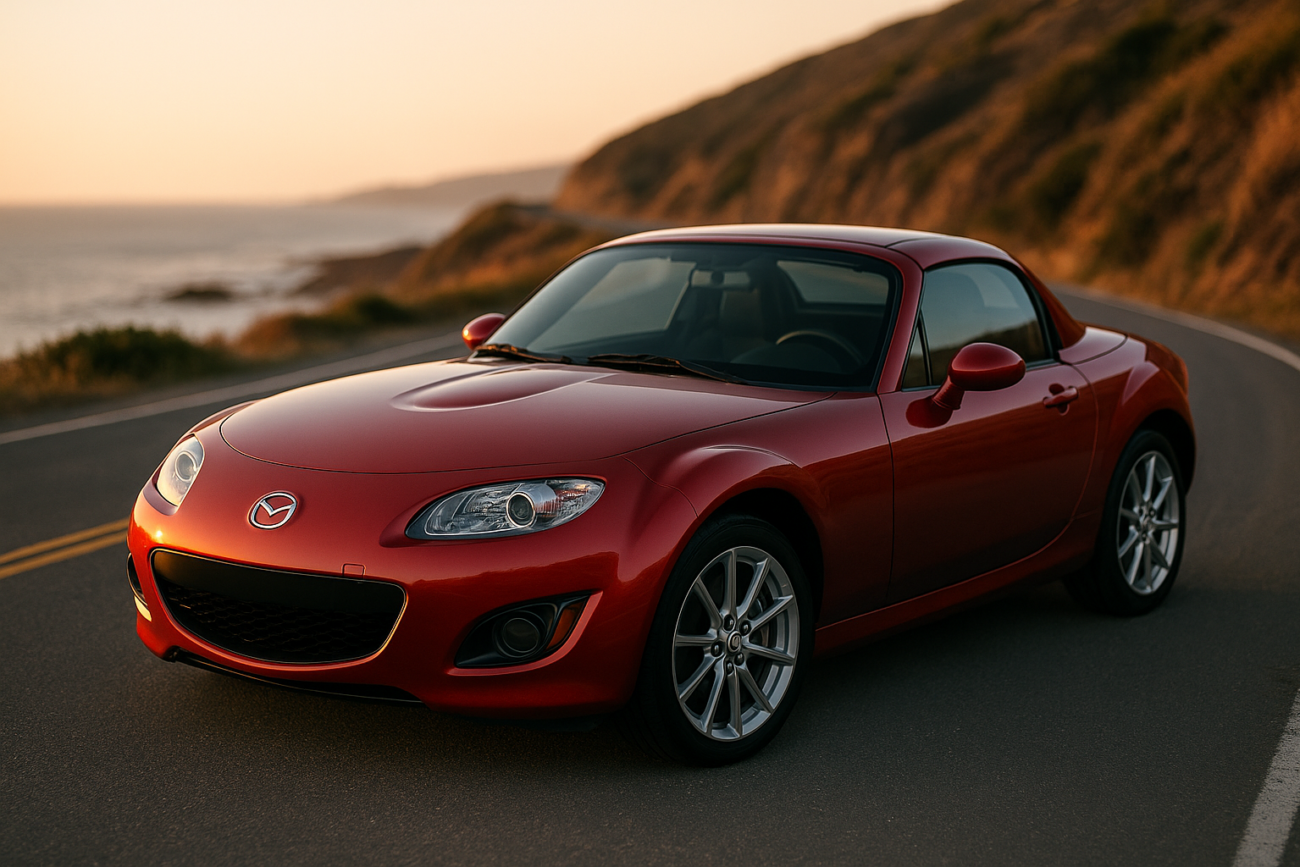
Why the 2010 MX-5 Matters
The 2010 Mazda MX-5 Miata sits in the middle of the NC generation (2006-2015), specifically the facelifted “NC2” run that ran from 2009 through 2012 with revised styling and interior trim. Mazda made no major mechanical changes for the year — the 2010 MX-5 Miata roadster continues to capture the hearts of driving enthusiasts and open-air aficionados everywhere, and dealer literature from the era is blunt about it: no major changes for 2010. That’s good news for a used-car buyer — it means the 2010 is mechanically identical to the well-sorted 2009-2012 cars, so you’re not gambling on a mid-cycle bug.
Engine, Transmission and Drivetrain
Every 2010 MX-5 uses the same 2.0-liter MZR four-cylinder. Every 2010 MX-5 is equipped with a 2.0-liter four-cylinder engine that produces 167 horsepower at 7,000 rpm with the manual transmission, and 140 pound-feet of torque at 5,000 rpm. Choose the automatic and you give up some output — horsepower ratings decrease slightly with the optional automatic transmission, and Mazda’s own literature lists it around 158 hp. Gearbox choice varies by trim: the Sport features a five-speed manual transmission, while the Touring and Grand Touring utilize a six-speed manual transmission, and a six-speed automatic with steering-mounted manual shift paddles is available for all trims. Fuel economy is a genuine strength for a sports car of this era — the 2010 Miata nets a city/highway fuel economy of 21/28 mpg with an automatic or six-speed manual transmission and 22/28 mpg with a five-speed manual, so it’s a viable daily driver, not just a weekend toy.
Curb weight is right around 2,527 lb, and the car rides on a 91.7-inch wheelbase — numbers that explain why the MX-5 punches well above its horsepower figure in the corners.
Trims and the Options That Actually Matter
The lineup runs Sport, Touring, and Grand Touring, with pricing that climbed from roughly $22,960 for a base Sport 5-speed up to about $29,500 for a Grand Touring with the power retractable hardtop (PRHT) and automatic transmission when new. The PRHT — Mazda’s folding hardtop that stows in the same trunk space as the soft top — was only offered on Touring and Grand Touring, not on the base Sport.
The single most important option to hunt for is the limited-slip differential. It isn’t standard, and it isn’t available on every trim — available on Touring and Grand Touring trims, the Suspension package features a sport-tuned suspension with Bilstein shocks and a limited-slip differential. That means a base Sport car cannot be optioned with an LSD at all, and a Touring or GT without the Suspension package will have an open differential and softer, non-Bilstein dampers. If you want the “as sporting as this generation gets” experience, you need a Touring or GT with the Suspension package, full stop. Separately, the top-of-range Grand Touring could be ordered with the Premium Package, which bundled Dynamic Stability Control with Traction Control, the limited-slip differential, Smart Key, Bluetooth and xenon headlamps — effectively the fully-loaded car.
Common Problems and Weak Points
The Power Retractable Hardtop (PRHT)
The PRHT is the single biggest mechanical complication this generation added over earlier Miatas, and it’s where most of the documented gremlins live. Two specific, corroborated faults show up repeatedly:
- Ticking/tapping noise on operation. Owners on Mazda-specific forums report a persistent tick from the top mechanism, traced to dry alignment pins; one owner of a 2010 PRHT GT specifically found that a smear of silicone or PTFE grease on the windshield-alignment pins cured it. It’s a known, cheap fix — but a top that ticks and hasn’t been addressed is a sign of a car that hasn’t been maintained by an enthusiast.
- Roof won’t cycle because of a dead window switch. Because the PRHT sequence requires the windows to drop first, a well-documented dry solder joint on the window-switch circuit board can strand the whole roof — there is a common fault with PRHT, a dry joint on the window switch circuit board, and without the window dropping the roof doesn’t work. It’s a known, repairable fault (reflow the joint or swap the switch pack), but it can look like a much scarier “roof system malfunction” to an unprepared buyer or seller.
Owner-logged repair data for 2010 cars specifically also shows at least one retractable hardtop motor/mechanism failure at very low mileage (just over 2,000 miles) requiring full disassembly, so age and lack of use — not just mileage — can be a factor with these mechanisms sitting unused for long stretches.
Suspension Top Hats and Bushings
This generation uses a conventional coil-over-shock front and rear setup, and the wear item to check is the upper shock mount (“top hat”), not the springs themselves — while springs seldom wear out, the shocks, the shock mounts and the bump stops do, and if the car jolts and crashes on even the tiniest of road imperfections, the upper mounts have probably collapsed. This is a cheap, well-understood fix (aftermarket top hats are a popular upgrade in the Miata community) but budget for it on any car with a choppy ride over expansion joints.
Rust — Check Rockers and Arches, Not the Frame
Rust is, by far and away, the MX-5’s biggest enemy, and the most likely locations to suffer from rust are the rocker panels and the fender arches. The earlier NB generation had a reputation for frame-rail rust, but that’s not considered a widespread issue on the NC. On a 2010 car, get underneath and inspect the rocker panels closely — corrosion often starts from the inside out, so a rocker that looks fine from three feet away can already be structurally compromised underneath the paint.
Minor Electrical and Exhaust Niggles
Consumer Reports data for the closely related 2012 MX-5 (same NC platform, same drivetrain family) lists exhaust system rattles — specifically a loose or rattling heat shield around the muffler and catalytic converter — as a recurring complaint, and it’s a cheap fix (a shop can often remove or re-secure the shield) rather than a sign of exhaust failure. Owner-reported repair logs specific to the 2010 model also show scattered small electrical items — an A/C system that needed evacuating and recharging after a factory-defective rubber grommet, and a battery that died on a car that had sat unsold on a dealer lot — neither of which points to a systemic defect, just the kind of thing any 10-plus-year-old convertible accumulates.
The Engine Itself Is the Strong Point
The engines are extremely robust and notorious for being nearly impossible to kill — this MZR 2.0-liter has a well-earned reputation for high-mileage durability when maintained on a normal oil-change interval. Owner-logged data for 2010 cars specifically shows only minor engine-adjacent items (a MAF/throttle body cleaning at 60,000 miles, one EGR valve replacement at 73,560 miles for a check-engine light) rather than anything structural — treat the EGR item as an isolated data point, not a pattern, since it’s a single reported repair.
Recalls and TSBs
Searches of recall-tracking sources did not surface a recall campaign specific to the 2010 model year in this research pass. That doesn’t mean “assume clean” — Mazda has recalled other Miata model years for real issues, including a 2016-2019 MX-5 automatic-transmission software recall in which a software problem in the transmission could cause an unexpected downshift, which may cause the vehicle to slow abruptly, and a more recent 2024-2025 recall over dashboard warning lights. Given Mazda’s recall history on this nameplate, run the specific VIN of any 2010 you’re considering through NHTSA.gov before you buy — it takes two minutes and costs nothing, and it’s the only way to be certain for that individual car.
On the TSB side, forum reports reference a Mazda technical bulletin (SB-01-028-10, issued August 2010) addressing variable valve timing (VVT) rattle or tick noise on cold start across multiple Mazda models of the era. If you hear a brief rattle from the front of the engine on first start that clears within a second or two, this is the likely explanation and generally isn’t a sign of impending failure — but have a Mazda specialist confirm the noise pattern rather than assuming it’s benign.
Reliability Track Record
The consensus across owner-survey data is “solidly average to good, not exceptional, not concerning.” The 2010 MX-5 Miata has about average reliability compared to other cars from the same model year according to Consumer Reports’ subscriber survey data, while owner-reported satisfaction elsewhere skews strongly positive — among 276 owners who provided feedback on the 2010 MAZDA MX-5 Miata for Kelley Blue Book, consumer sentiment is overwhelmingly positive, with 98% recommending the vehicle. Independent repair-tracking data (TrueDelta) for 2010-specific cars, based on a small sample of 16 logged repairs, skews heavily toward electrical and A/C items (56% of logged repairs) with engine and suspension/steering issues each accounting for about 13% — consistent with the “mostly minor niggles, not drivetrain failures” picture from other sources. One outlier worth flagging: a single KBB reviewer reported a clutch that failed at just 8,000 miles and was replaced under warranty — this is not corroborated anywhere else in the data pulled for this guide and should be read as an isolated incident, not a characteristic fault.
Pre-Purchase Inspection Checklist
- Cycle the top (soft or PRHT) multiple times with the engine running. Listen for the tick from the alignment pins, confirm the windows drop fully before the roof moves, and check that it latches cleanly to the windshield header without forcing.
- Get underneath with a flashlight and a pick. Focus on the rocker panels and fender arches specifically — press on painted rocker sections to check for soft, bubbled metal underneath.
- Drive it over broken pavement. A car that crashes and jolts over small bumps likely needs top-hat/shock-mount attention.
- Confirm LSD equipment if that matters to you — check the build sheet/window sticker or ask Mazda to decode the VIN, since Sport-trim and base Touring/GT cars without the Suspension package run an open diff.
- Check convertible-top drain channels for debris (leaves, seed pods) — clogged rear drains have caused water intrusion into the footwells and carpet on this generation.
- Run the VIN through NHTSA.gov for any open recall specific to that individual car, regardless of what general research says about the model year.
- Verify service history for regular oil changes. The MZR engine has a strong reputation for longevity, but that reputation assumes basic maintenance was actually done.
Which Configuration to Seek Out (and Which to Think Twice About)
For a driver’s-car buyer, the sweet spot is a Touring or Grand Touring with the Suspension package (Bilstein shocks plus the limited-slip differential) and the six-speed manual — the manual’s higher power rating and the LSD together are what make this generation feel properly sporting rather than just quick in a straight line. A base Sport model is cheaper but comes with a 5-speed gearbox and no LSD option at all, which matters if you plan on any spirited driving or track days. The PRHT is a genuine convenience (coupe-like security and weather sealing with a hardtop, without giving up trunk space when the roof is down), but it’s also the single most mechanically complex part of the car — a well-sorted soft-top car with no roof-electronics history is arguably the lower-risk buy if you just want simplicity. Automatic-transmission cars exist and are fine as commuters, but they give up meaningful horsepower and most of what makes a Miata a Miata, so they tend to be the least desirable on the resale market among enthusiasts.
Values and Running Costs
Pin-pointing a firm price range for this guide is difficult because used-car values move constantly and vary hugely by region, mileage, and top type — treat any number here as a rough anchor, not gospel, and check live listings before you commit. The one hard data point available is a Kelley Blue Book trade-in valuation of roughly $4,650 for a higher-mileage (77,427-mile) example, which gives a sense of where well-worn, non-collector cars land; clean, low-mileage, manual-transmission cars with the Suspension package command meaningfully more. New MSRP for the 2010 ranged from about $22,960 for a base Sport manual up to around $29,500 for a loaded Grand Touring PRHT automatic, for reference on how the trims stacked when new.
On running costs, expect Miata ownership on this generation to be cheap by sports-car standards: parts are shared across a huge production run, independent specialists and forums are deep with knowledge, insurance is typically inexpensive given the modest power output, and fuel economy in the low-to-high 20s mpg is genuinely usable as a daily. The main things that will actually cost money over a long ownership stint are the PRHT mechanism (if something beyond the common fixes goes wrong), rocker-panel rust repair in salt-belt climates, and eventual suspension bushing/top-hat replacement — none of which are expensive relative to other sports cars, but none of which are free either.
