Why the SLR McLaren Still Matters
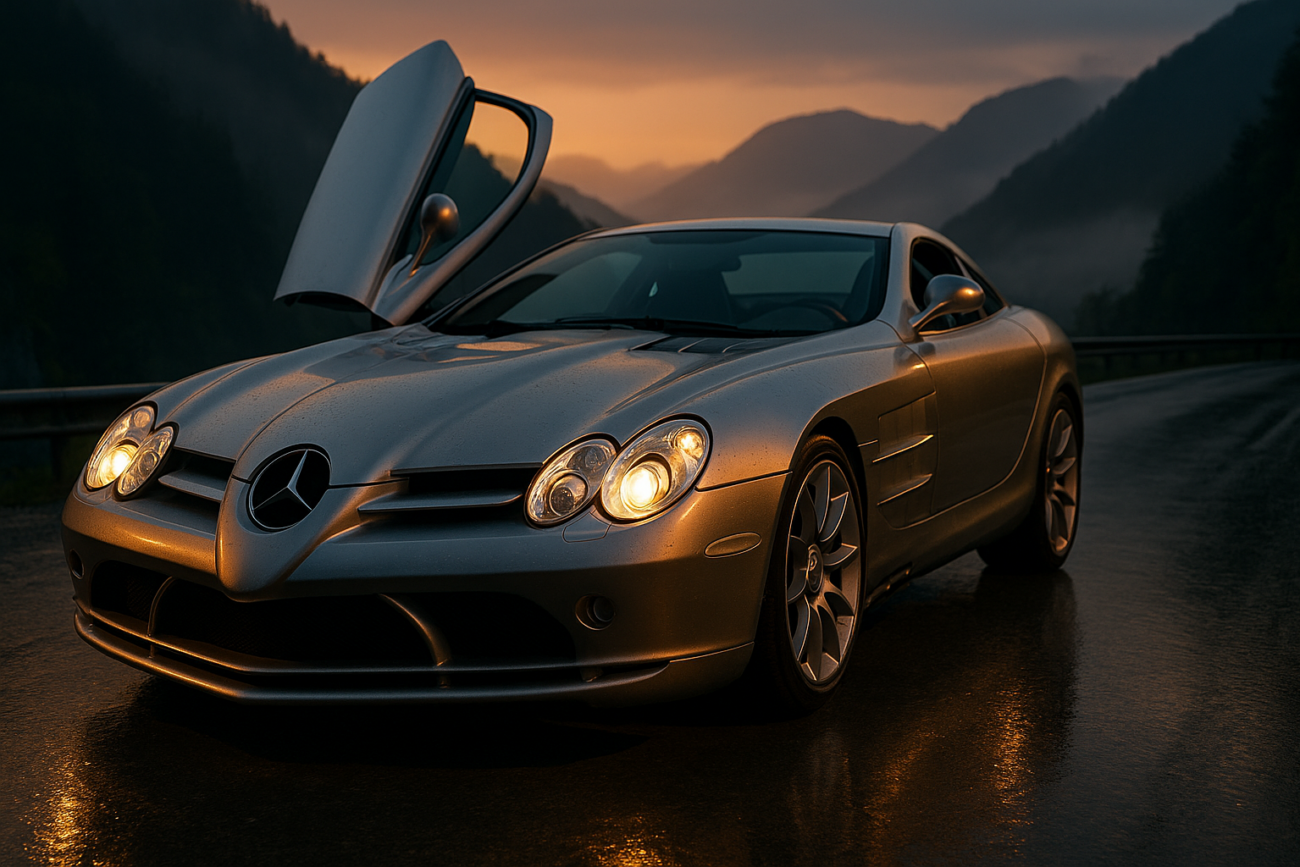
The Mercedes-Benz SLR McLaren was never a normal supercar, and that’s exactly why it’s becoming one of the more interesting used exotics to buy today. Built as a joint venture between Mercedes-AMG and McLaren Cars at the McLaren Technology Centre in Woking, England, the SLR (chassis code C199) combined an AMG-built supercharged V8 with a full carbon fiber monocoque chassis, dihedral doors, and a genuinely eccentric list of engineering party tricks — an automatic air brake, a nose that lifts for speed bumps, and side-exit exhausts you have to step over to get in. For a while it was dismissed as a slow-shifting, style-over-substance GT. Now, with the transmission complaints in perspective and the carbon chassis looking increasingly ahead of its time, it’s aging into a genuinely important early-2000s halo car.
Generations and Trims to Know
- Coupe (2004–2009): The core car. A 2006 example sits comfortably in the mid-production run, after early build-quality kinks were sorted and before the run-out special editions arrived.
- 722 Edition (introduced for 2006): Named after Stirling Moss and Denis Jenkinson’s race number in the 1955 Mille Miglia, which they won in a Mercedes 300 SLR. The 722 got a power bump, stiffer suspension, lighter forged wheels, a fixed rear wing in place of the automatic airbrake’s usual profile, and unique trim. It’s the coupe most collectors specifically hunt for.
- Roadster (from 2007): Convertible version with a manually stowed soft top (no folding hardtop). Came after the 2006 model year, so a 2006 car will always be a coupe.
- 722 S Roadster and Stirling Moss (later, limited runs): Even rarer run-out specials from the very end of production; largely outside the scope of a “2006 SLR” search but worth knowing about if you’re cross-shopping the range.
Bottom line for a 2006-specific search: you’re looking at either a standard coupe or a 722 Edition coupe, since the Roadster hadn’t launched yet that model year.
Engine and Drivetrain
Every SLR uses an AMG-built 5.4-liter supercharged SOHC V8 (derived from the M113 family) sending power through a rear-mounted five-speed automated-manual transmission, marketed as AMG SpeedShift (SSG). The standard car is generally quoted at over 600 horsepower and roughly 575 lb-ft of torque; the 722 Edition gets a mild power increase over the standard coupe. It’s a genuinely quick car for its era, with 0-60 mph in the high-3-second range and a top speed well north of 200 mph — but always confirm the exact factory figures against a period spec sheet, since numbers get repeated inconsistently online.
The transmission is the single most talked-about mechanical trait of this car, and it deserves its own section below.
The Biggest Known Weak Point: The SSG Transmission
The SLR’s AMG SpeedShift SSG is a single-clutch automated manual, not a torque-converter automatic and not a dual-clutch. Period road tests and long-term owner accounts consistently describe the same behavior: smooth and quick once you’re moving hard, but notably clunky and hesitant at low speed — jerky take-off from a stop, a pause between shifts, and an awkward reverse engagement. This isn’t a rare fault on one bad car; it’s a characteristic of the design that showed up across the model’s production run and was a common criticism in contemporary reviews.
- On a pre-purchase drive, pay attention to how the car behaves crawling in traffic and engaging reverse — some hesitation is normal for the design, but excessive shudder, grinding, or a warning light on the dash is not.
- Because this is a low-volume, specialist transmission shared with no mainstream Mercedes product, parts and rebuild expertise are concentrated in a small number of AMG/SLR-trained technicians. Get any car with unusual transmission behavior inspected by a specialist before you buy, not a general Mercedes shop.
- Ask for service records showing the transmission fluid/clutch actuation system has been maintained on schedule — neglect here is expensive to unwind.
Carbon Fiber Monocoque and Body
The SLR was the first Mercedes-Benz production car built around a full carbon fiber monocoque, with carbon front and rear crash structures bonded to the tub. This is fantastic for rigidity and safety, but it changes the economics of any accident damage — carbon monocoque and body panel repair requires specialist facilities and cannot be treated like sheet-metal bodywork. Before buying, get a full paint-meter and structural inspection specifically looking for:
- Any evidence of prior accident repair, especially to the nose, sills, or rear crash structure.
- Curb rash or cracking on the front splitter and undertray — the SLR sits very low, and the front end is vulnerable to speed bumps and steep driveway approaches. The factory even built in a front-axle lift function for exactly this reason; confirm it works.
- Condition of the carbon around the side sills near the exhaust exits (see below).
The Air Brake and Other Signature Systems
The SLR’s rear deck spoiler automatically deploys upward under hard braking at speed to act as an air brake, then retracts. It’s a genuine engineering feature, not a styling gimmick, and it relies on electric actuators and sensors that can develop faults over nearly two decades of service. During a pre-purchase inspection, have the seller (or a specialist) confirm the airbrake deploys and retracts correctly and that there are no related warning lights. The same goes for the front-axle lift system used to clear speed bumps and steep ramps — test it, don’t just take a seller’s word for it.
Side-Exit Exhausts: Cool Sound, Real Ergonomics Problem
The SLR routes its exhaust out through side-exit pipes ahead of the doors rather than at the rear — part of why the car sounds the way it does, and also why owners and reviewers have long noted you need to be careful not to brush bare skin or clothing against the sills when getting in or out shortly after driving. It’s a known quirk of the design rather than a defect, but it’s worth experiencing in person before you commit, and worth checking the surrounding carbon/paint for heat-cycling damage over time.
Wear Items That Bite Hard on This Car
- Tires: The SLR uses a bespoke Michelin tire specified for the car’s weight, speed, and airbrake-related handling characteristics. Availability is narrower than for a mainstream performance tire and a set is a genuinely expensive line item — budget for a specialist quote rather than assuming a generic ultra-high-performance tire will do.
- Carbon-ceramic brakes: The SLR was one of the earlier production cars to use carbon-fiber-reinforced ceramic brake discs. They resist fade brilliantly and last a long time under normal use, but they are costly to replace when they do wear out or if they’ve been damaged by track use or an accident. Get pad and rotor wear checked as part of any PPI.
- Battery and electronics: Like most low-mileage exotics that spend a lot of time sitting, SLRs are prone to battery drain issues if not kept on a trickle charger/battery maintainer between drives. Ask how the car has been stored and whether a maintainer was used.
Recalls and TSBs
Manufacturer recalls do exist across the SLR’s production run, as with virtually any car of this era, but exact campaign details (airbag, fuel system, or other components) should be confirmed against the current NHTSA database using the specific VIN of any car you’re considering — recall status can change and campaigns can be added retroactively, so don’t rely on a used-car listing’s claim that “all recalls are done.” This is a check every buyer should run themselves before finalizing a purchase.
Pre-Purchase Inspection Checklist
- Full compression/leak-down check and supercharger inspection on the M113 V8; listen for supercharger bearing whine at idle and under load.
- SSG transmission behavior at low speed, in reverse, and under full-throttle upshifts — have a specialist scan for stored fault codes.
- Airbrake spoiler deployment/retraction test and front-axle lift system test.
- Full visual and paint-depth inspection of the carbon monocoque and body panels for prior accident repair, especially the nose and front splitter.
- Carbon-ceramic brake rotor and pad wear measurement.
- Tire date codes and remaining tread — confirm they’re the correct specified tire, not a substitute.
- Full service history from an AMG/SLR-capable specialist, including transmission service intervals.
- Confirm all convenience electronics (climate control, navigation-era infotainment, power seats) function — these cars are old enough that electrical gremlins in ancillary systems are common and can be tedious to diagnose.
- VIN-specific recall check through NHTSA before you buy.
Which Cars to Seek Out — and Which to Be Wary Of
A well-documented 2006 standard coupe with full service history from an AMG/SLR specialist is a reasonable entry point into SLR ownership. The 722 Edition commands a real premium and is the one most collectors specifically target, thanks to its rarity, the Stirling Moss connection, and the mechanical tweaks — if budget allows, it’s the more desirable car long-term. Be wary of any SLR — standard or 722 — with a gap in service history, evidence of deferred transmission maintenance, unexplained bodywork, or a seller who can’t clearly explain how the car has been stored and maintained during long periods of inactivity. Given how specialized and low-volume this car is, a thin paper trail is a much bigger red flag here than on a mainstream used Mercedes.
Ownership Costs and Value Trajectory
The SLR McLaren followed the classic “expensive-flagship depreciation curve”: it launched at a very high price, was heavily criticized in period for the SSG transmission’s low-speed manners, and depreciated substantially for years afterward relative to its original sticker. More recently, interest in early-2000s analog-feeling supercars with genuine engineering novelty (carbon monocoque, airbrake, AMG/McLaren pedigree) has pushed enthusiast and collector interest back up, particularly for the 722 Edition and the later Roadster variants. Exact current values move with the broader collector-car market and vary significantly by condition, mileage, and documented history, so treat any specific number you see quoted online as a starting point for negotiation, not gospel — get a current appraisal or recent comparable sale before you commit real money. Running costs to plan for beyond the purchase price include specialist servicing, tires, carbon-ceramic brake wear if driven hard, and insurance appropriate to a limited-production exotic.
The Bottom Line
The 2006 SLR McLaren is not a car to buy casually or to service at a generic shop. It rewards buyers who do their homework: find a car with a clean carbon monocoque, a healthy SSG transmission with documented maintenance, working airbrake and nose-lift systems, and a paper trail from technicians who actually know this car. Do that, and you get one of the most distinctive and increasingly significant Mercedes-AMG/McLaren collaborations ever built — a genuine engineering oddity that’s finally being appreciated for what it is rather than judged against expectations it was never really trying to meet.
