Why the 1973 Carrera RS 2.7 Matters
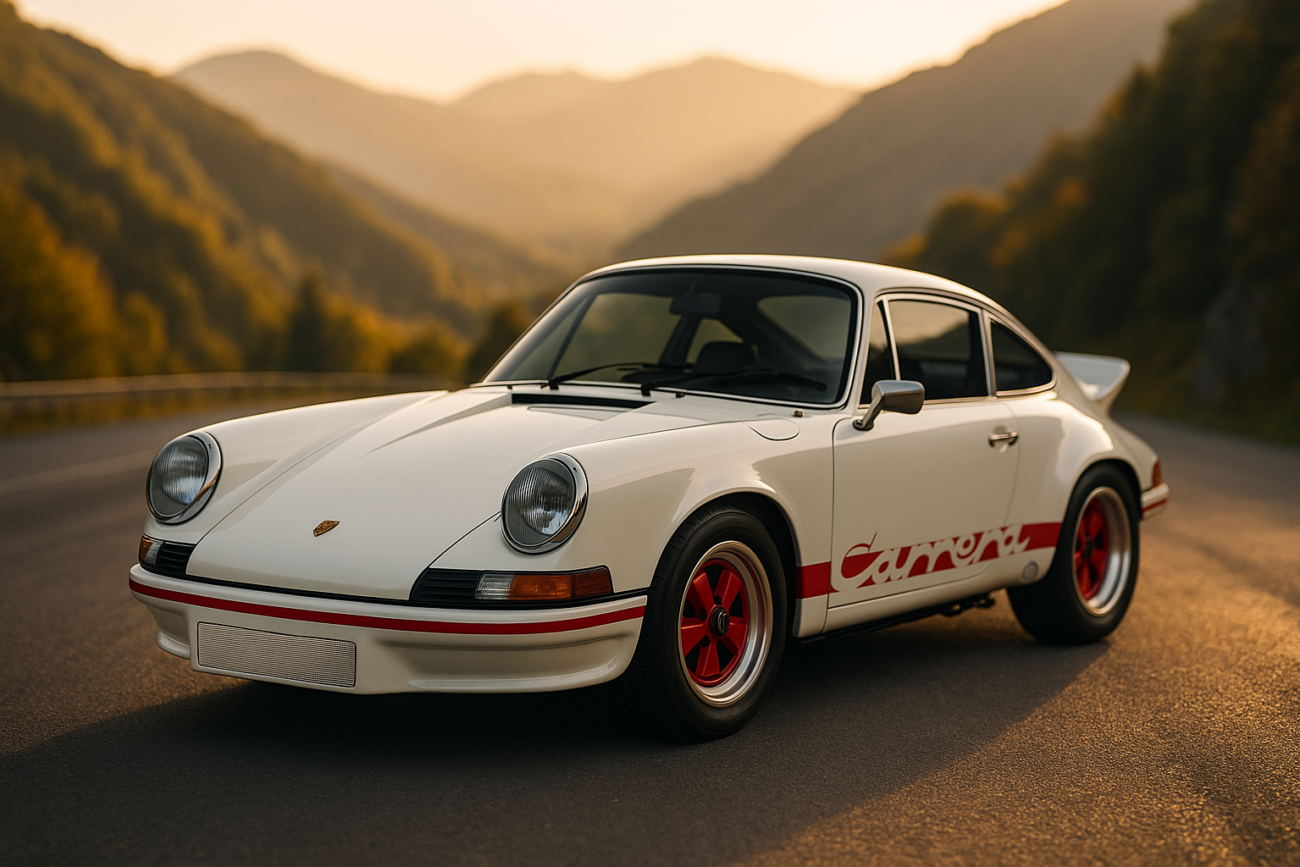
No car looms larger in Porsche folklore than the 1973 911 Carrera RS 2.7. It is the car that gave the 911 its ducktail, its “Carrera” script, and its reputation as the thinking enthusiast’s supercar. Within that single model year sits an even rarer, even more coveted variant: the M471 “Lightweight,” commonly shortened to the RS Lightweight or RSL. This guide focuses on that car — what it is, why it exists, what to check before you buy one, and what it’s worth today.
The Homologation Story
The FIA mandated that at least 500 examples of the RS were required, so Porsche set to work. In the early 1970s, FIA Group 4 (Special GT) racing required manufacturers to produce at least 500 road-legal examples of a car before it could be homologated for competition. Porsche’s motivation wasn’t a vague marketing exercise — the 1973 RS was the Homologation-Series 911 Porsche had to build in order to qualify its pure racing 2.8-litre 911 RSR for competition. Two versions were offered, both based on the 1973 911S 2.4 coupe: a touring version M472, which retained much of the interior trim and features of the standard car, and a Lightweight/Sport option M471 that served as the racing-oriented basis for the RSR.
The Four Faces of the 2.7 RS
Most buyers arrive thinking there are two RS 2.7s — Lightweight and Touring. In reality there were four distinct specifications built off the same production line, and understanding the split matters enormously for valuation and authenticity checks.
- RS H (Homologation): The first 17 examples off the line were badged RS H (for Homologation) — the earliest, purest cars, effectively the base spec the later M471 package was built from.
- M471 “Sport” / Lightweight: 200 Lightweight Sports (M471) were made. Of all the 1,580 Carrera RS 2.7s, only 200 were made were ordered with this lightweight ‘Sports’ trim, which made the car more responsive and purposeful. These are the cars this guide is chiefly concerned with.
- M472 Touring: 1,308 customers chose the M472 package, which equipped the RS more like a 911S — adding some creature comforts — known as the RS Touring models. 1,308 were built to M472 Touring specification, of which 100 were right-hand drive.
- RSR racing cars: 55 RSR racing cars were also produced from the same homologation base, built as full competition machines rather than road cars.
A total of 1,580 2.7 RS cars were built across all four specifications — a genuinely small production run for what became one of the most replicated silhouettes in the collector world.
What Actually Makes the Lightweight “Light”
The M471 package wasn’t a trim level in the modern sense — it was a deliberate strip-out. Reports of 75kg were stripped from the standard model by fitting lightweight body panels and lightweight glass, resulting in a nimble 900kg car compared to its Touring counterpart at 975kg. The bumpers are fiberglass instead of steel, and sound deadening material was removed.
Inside, the difference is stark. The RS ‘Sport’ or ‘Lightweight’ (conversion M471) took an RSH and added bigger wheels, carpet in the luggage compartment and a better passenger seat. The carpet is thin felt overlaid with rubber mats, the glass is thinner too, and you hear every granule of grit flicking into the arches or tinkling along the floorpan. There’s no radio. One sun visor. No armrests. A blank circle of plastic sits in place of a clock. The low-back Recaro bucket seats are thinly padded lightweight items too, and for the first series of Lightweights, the Porsche crest was a weight-saving sticker instead of a metal badge. If you’re inspecting a car sold as a genuine M471 and it has a full radio delete, thin door panels, a sticker crest (early cars), and unusually thin glass that’s noticeably lighter to lift, that all tracks with the factory spec — a fully trimmed-out, sound-deadened, radio-equipped car wearing Lightweight badges should raise questions immediately.
Engine, Drivetrain and Performance
Every 2.7 RS, Lightweight or Touring, shares the same drivetrain. The engine is a 2,687cc air-cooled horizontally-opposed flat six, built between November 1972 and July 1973, mated to a five-speed manual transmission, producing 210 bhp at 6,300 rpm and 188 ft-lb of torque at 5,100 rpm. That was fed by Bosch mechanical fuel injection rather than carburetors, a genuine step up in both output and driveability for the era. The 1973 RS 2.7 introduced the ducktail spoiler, the first fixed rear spoiler fitted to a production car — a functional aerodynamic aid that has since become one of the most copied styling cues in the automotive world.
In its lightest form, the car weighs as little as 2,116 lbs (960kg) in Homologation trim, and Porsche’s own quoted weight puts the M471 at 900kg against the Touring’s 975kg. In period this combination of light weight and a genuinely quick-revving MFI six made it one of the fastest-accelerating road cars sold anywhere.
