
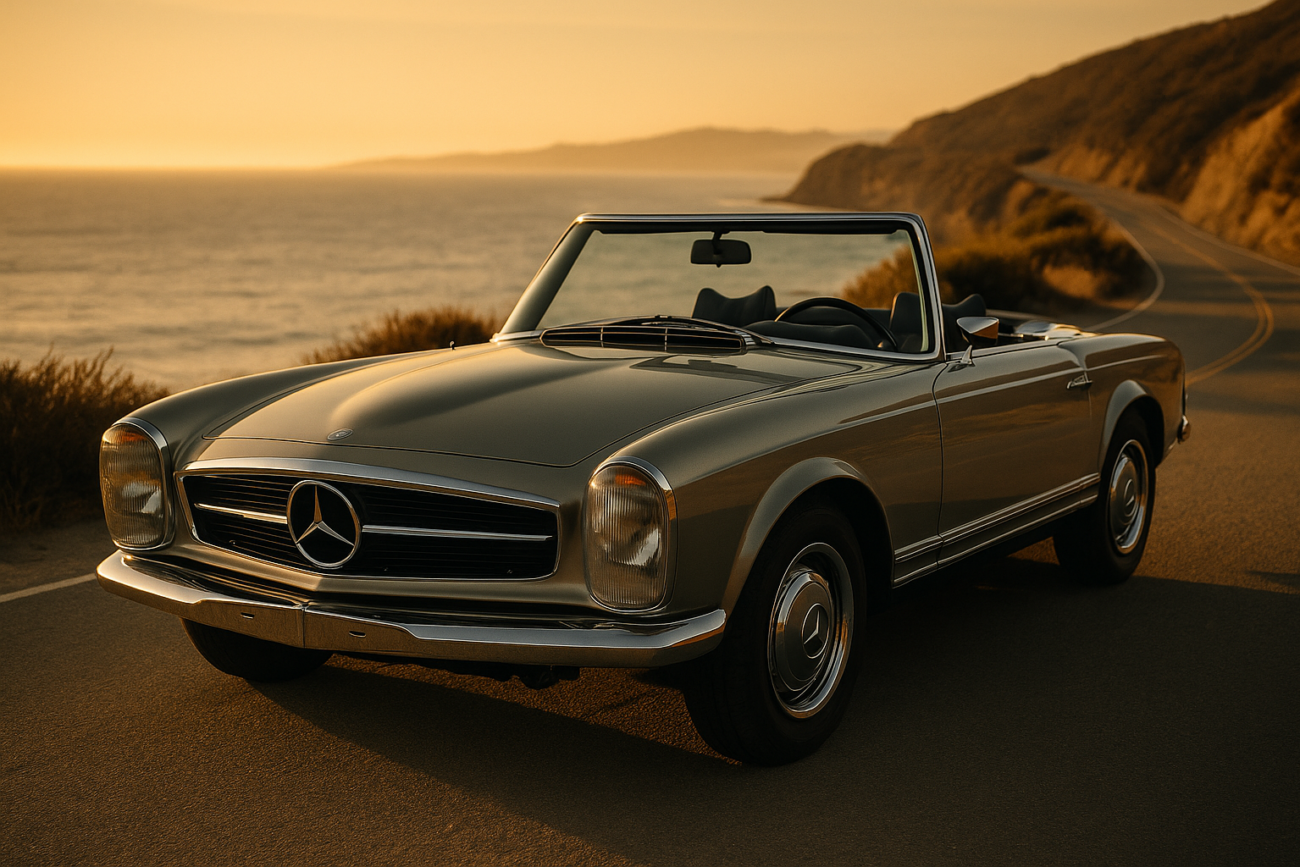
What Is the 1966 Mercedes-Benz 230SL “Pagoda”?
The 230SL was the car that launched Mercedes-Benz’s W113 SL generation, and the 1966 model year sits right in the middle of its short production run. Mercedes debuted the 230SL at the Geneva Auto Show in March 1963, to great acclaim, and its exterior styling was a departure for Mercedes, which had until that point relied on rounded, even bulbous curves to characterize its automobiles. The car’s boxy, clean-lined shape combined with a removable hardtop whose roofline dipped in the middle and rose at the edges earned it the “Pagoda” nickname that has stuck ever since.
Underneath, the 230 utilized a monocoque chassis borrowed from the 220 series sedan, with front suspension by coils and wishbones, while the rear incorporated a single-pivot swing axle and transverse springs set up to compensate for camber, and Girling disc brakes stopped the front wheels, with power-assisted drums working the rear. Power came from a 2.3-liter overhead-cam inline six carried over and enlarged from the 220 series, fitted with Bosch mechanical fuel injection, with horsepower on the new sport tourer rated at 148 — a significant boost over the underpowered 190SL it replaced. A 4-speed manual transmission was standard, though a new 4-speed automatic transmission was optional — a first for Mercedes sports tourers of this nature. The car in this guide, with its 4-speed manual, is the more driver-focused of the two original transmission choices.
The 230SL wasn’t just a boulevard cruiser, either. Despite seeming delicate, it proved to be a masterful endurance rally car, as demonstrated by its win at the gruelling 1964 Spa-Sofia-Liège. It was also expensive and glamorous in period — the W113 cost roughly twice as much as a 4.2-liter Jaguar E-type, and Charlton Heston and John Lennon were among its period owners. Production ran through early 1967, when the 230SL gave way to the 250SL; of the 19,831 230SLs produced, less than a quarter were sold in the US, which is worth remembering — most surviving cars are European-delivery, and many U.S.-market cars you’ll find today have been reimported or converted.
The 4-Speed Manual: What Makes This Combination Different
Most 230SLs that stayed in North America left the factory with the automatic, so a 4-speed manual example is the more mechanically engaging and, for many enthusiasts, the more “correct” way to experience the car as originally conceived. Roughly three-quarters of all 230SLs were built with the manual gearbox, against only about a quarter with the automatic — a split that reverses further up the range, where 90 percent of 280SLs went out the door with the automatic. That makes a manual 230SL a genuinely representative, high-production-share configuration for this specific model, not a rare unicorn — but it’s still the transmission most enthusiasts actively seek out.
One nuance specific to a 1966 car: from May 1966, Mercedes introduced the ZF S5-20 5-speed manual as an additional, more expensive option, one that proved particularly popular in Italy. Depending on exactly when in 1966 a given car was built, it could theoretically have left the factory with either gearbox. If you’re evaluating a “1966 230SL 4-speed,” confirm via the data card or chassis records that the 4-speed is factory-original for that specific build date, not a later swap in either direction.
Owners and specialists are consistent that the 4-speed’s gearing was tuned for the era’s roads and speeds, not modern highway cruising. Mercedes’ own club literature notes that the engine turns at a loud 3,500–4,000 rpm at highway cruising speed, depending on rear-axle ratio, and that owner fixes for this characteristic high cruising rpm have included fitting overdrives, non-original transmissions, or differentials borrowed from other Mercedes-Benz models. This isn’t a fault so much as a period-correct trait — but it explains why you’ll see 230SLs on the market with later 5-speed or 6-speed conversions. One owner testimonial on a specialist’s conversion product page, illustrative rather than definitive, put it plainly: the factory “old 4 speed transmission demanded such high RPM from the engine” for extended highway driving. Within the gearbox itself, wear is mechanical and predictable rather than dramatic: shift bushings are often worn and aged, and if they deteriorate enough they can break and fall out, making it difficult to find the gears — a vague, sloppy shifter is a bushing problem, not usually a sign of internal gearbox failure.
Engine and Fuel System: Living With Bosch Mechanical Injection
The 230SL’s M127 2.3-liter six is fitted with a Bosch six-plunger mechanical fuel injection pump. On the club side, this system is regarded with real respect: it’s a six-plunger unit driven at half engine speed, injecting fuel into the head behind the intake valves, and even today this pump is considered a reliable, technical marvel. On the 230SL specifically, it used the Bosch R11 pump, which was replaced fairly quickly in subsequent years by the R18 and eventually the R20 — so parts and rebuild specifics for a 1966 230SL’s pump are not automatically interchangeable with a later Pagoda.
The failure modes that keep coming up across specialist and marque sources are consistent enough to treat as characteristic rather than anecdotal:
- Valve stem seals: blue smoke on acceleration is likely to be hardened or worn valve stem seals — common on an engine of this age regardless of use pattern.
- Injection pump wear from dirty oil: dirty oil can damage the pump, and a rebuild costs £1,000-plus — regular oil changes matter more on this engine than on a typical carbureted classic.
- Rusty injector lines after storage: neglect or lack of use can cause rust in the pipework that blocks the injectors, so expect near-instant starting on a healthy example and be suspicious of a car that’s hard to start after sitting.
- Internal fuel tank rust: this is well corroborated by a real-world case study — a specialist workshop documented a 1966 230SL that arrived with a running fault where, after roughly 15 minutes, the car would stall, then restart and run for another 15 minutes before stalling again, after being recommissioned following 14 years in storage. The cause was rust particles breaking off inside the tank and blocking the tank, fuel pump, and main fuel filter, causing fuel starvation. If a car has been in long-term storage, budget for a fuel tank inspection or replacement; a reproduction tank runs roughly £500, and you should look as far as you can see inside the fuel filler for rust, since tanks corrode in cars that have stood for long periods.
- Head gasket: flagged by the same specialist source as a periodic failure point, particularly on cars that have sat idle for extended stretches.
Bottom line: a leak-down and compression test is non-negotiable before purchase. A leak-down and compression test will provide a basis for evaluating engine health, and given the cost of fuel-system work on this car, it’s worth paying a specialist to also cycle the injection pump and check for smooth, even injector spray before you commit.
Rust: The Single Biggest Risk on Any Pagoda
Every credible source on this car agrees on one thing: rust, not the drivetrain, is what separates a good buy from an expensive mistake. The Mercedes-Benz Club of America’s own buyer’s guide doesn’t soften this: rust is a major problem, and extensive rust may render the W113’s unit-body chassis unrepairable. A UK specialist dealer’s guide is just as blunt about the market around it: expect sellers to attempt to hide rust issues, since this is one of the most expensive problems to rectify.
The specific trouble spots named across multiple independent sources are:
- Inner structure forward of the firewall, the inner aprons, and the floorboards — rust is a common issue, particularly in the inner aprons, structure from firewall forward, and floorboards.
- The battery tray and surrounding firewall area — a widely reported weak point on Mercedes of this era generally, worth a flashlight-and-mirror check even if the tray itself looks freshly painted.
- The fuel tank, from the inside — covered above; check the filler neck for scale and flaking, especially on a car that’s been dry-stored.
- Sills, wings, and front bulkhead — cosmetic sill covers and freshly fitted front wings are a known way to disguise structural corrosion underneath; insist on a look with the car on a lift, not just a walk-around.
Rust on this car is rarely an immediate safety or reliability failure — rust is unlikely to cause an immediate breakdown while driving, but it can be one of the most expensive issues to repair, since a quality repair requires a significant amount of labor — but it compounds. Left unaddressed, existing rust that isn’t addressed will eventually lead to a situation where a complete restoration becomes the only viable solution. Walk away from, or heavily discount, any car with visible perforation in structural areas unless you’re specifically buying a restoration project and pricing it as one.
Recalls and Known Service Bulletins
We were not able to identify a specific, well-documented factory recall campaign tied to the 1966 230SL in the sources reviewed for this guide. That’s not unusual for a car this old — recall record-keeping from the mid-1960s is patchy in modern searchable databases, and it should not be read as confirmation that no campaign ever existed. If a recall or factory service action matters to your purchase decision (for example, on brakes or fuel system components), have your editor or a marque specialist check period Mercedes-Benz service bulletin archives and any surviving dealer records directly rather than relying on modern online recall lookups, which skew toward newer vehicles.
Pre-Purchase Inspection Checklist
- Compression and leak-down test on all six cylinders before you negotiate — this provides the basic evidence of engine health that everything else builds on.
- Inspect the fuel tank through the filler neck with a flashlight and mirror for internal rust, especially if the car has sat for any extended period.
- Check oil condition and service history — dirty, neglected oil is directly linked to injection pump wear and a four-figure rebuild bill.
- Look for blue smoke under load on a test drive (hardened valve stem seals) versus smoke only at cold start or idle.
- Get the car on a lift and inspect the firewall-forward structure, inner aprons, floorboards, sills, and battery tray for rust or filler, not just the visible painted surfaces.
- Check for a matching-numbers data card, and confirm the transmission (4-speed manual, in this case) matches what the car’s build records say it left the factory with — remember the ZF 5-speed became a factory option partway through 1966.
- Test the shifter for vagueness or looseness, which usually points to worn shift bushings rather than internal gearbox damage.
- Confirm presence and condition of both the soft top and the removable hardtop — most Pagodas were sold with both, and a missing hardtop is a real cost to replace.
- Note whether the car is a “California Coupé” configuration (hardtop only, hood well replaced by a folding bench for occasional 2+2 seating) if seeing a soft-top boot — this variant is genuine but rare and, at least in the UK market, not especially sought-after.
- Evaluate brakes and suspension bushings on the test drive; on the 230SL specifically, remember the factory setup is front discs with rear drums, not the four-wheel discs used on later 250SL/280SL cars.
- Budget time and money for a specialist pre-purchase inspection rather than relying on a general classic-car mechanic — the fuel injection system in particular is a specialty skill set.
Trim, Spec, and Variants to Know
A few configuration details are worth understanding before you shop:
- Manual vs. automatic: the 4-speed manual in this guide represents the majority build for the 230SL specifically, even though it’s the minority choice further up the W113 range.
- 4-speed vs. 5-speed manual: from May 1966 the ZF S5-20 5-speed became an extra-cost option; verify which gearbox your specific 1966 car left the factory with.
- Brakes: the 230SL used power-assisted dual-circuit Girling front discs with rear drums, changing to four-wheel ATE discs on the 250SL and 280SL — don’t assume four-wheel disc performance on this car.
- Soft top / hardtop combination: most cars were sold with both a soft top and a removable hardtop, though some were soft-top only — check both are present and in usable condition, as reproduction tops and glass are a real expense.
- Jump seat: a factory option fitting a small side-facing seat for occasional use, distinct from the California Coupé’s rear bench — don’t confuse the two when reading a listing.
- US vs. Euro-market cars: US-market cars are increasingly being repatriated to Europe as values rise; they can make good restoration projects if genuinely rust-free from a dry climate, but budget for the cost of converting specification where needed.
Market Values: What to Expect to Pay
Pagoda values have risen steadily as the model has been rediscovered by a broader collector base, and the market is wide — from tired projects to concours-level cars — so “what’s it worth” depends heavily on condition, originality, and paperwork.
As a general benchmark, the average recorded transaction price across the 230SL Pagoda market is around $71,582, though that figure blends everything from rough drivers to fully restored cars and doesn’t reflect the extremes. At the top end, exceptional or unusual cars can bring far more — the highest recorded sale in this market was $1,215,000, for a 1964 230SL Coupe Speciale, a coachbuilt outlier that shouldn’t be used as a benchmark for a standard steel-bodied car. At the accessible end of the market, commentary from specialist auction-market analysts describes a roughly $30,000 entry point that typically buys a 230SL or 250SL, frequently an automatic, in somewhat tatty but usable condition, often a European-market car with imperfect rust repairs.
For context on a genuinely well-documented example, a UK-supplied, right-hand-drive 230SL (automatic, not manual) with matching numbers and a complete service history was recently offered with a guide price of £60,000 to £70,000 — useful as a data point for what a clean, well-papered, honestly-presented car commands in that market, even though it isn’t the manual gearbox covered here. Manual-transmission cars don’t automatically command a premium over automatics in every market — European buyers in particular are reported to be less fussy about transmission and trim distinctions than American buyers, who have historically shown a strong preference for the later 280SL. As one market analyst put it, “To most of us, it’s the 280SL — or no Pagoda at all,” a bias that can work in a 230SL buyer’s favor on price relative to a comparable 280SL.
Treat every number above as a starting point for negotiation, not a fixed price list — get a current Hagerty Price Guide pull and at least two or three live comparable listings before making an offer or setting an asking price.
Ownership Costs and Parts Availability
The good news for a 230SL owner is that the W113 is one of the best-supported classic Mercedes platforms in the aftermarket. Specialist suppliers — including SLSHOP, Bud’s Benz, and Miller MBZ — stock reproduction and NOS parts specifically cataloged for the W113 230SL/250SL/280SL range, and pump rebuild specialists exist specifically for the Bosch mechanical injection system used on this car. That said, specialist labor isn’t cheap, and a few known cost items are worth budgeting around from the start:
- Fuel injection pump rebuild: roughly £1,000-plus at a UK specialist if dirty oil has damaged the pump — get a current local quote, as this is one of the most specialized and highest-value services on the car.
- Reproduction fuel tank: roughly £500 if internal rust has progressed too far to save the original.
- Gearbox bushing wear: a comparatively inexpensive fix relative to the injection system, but worth factoring in if the shifter feels vague.
- Rust repair: the widest possible cost range on the car — from a localized patch to a full structural rebuild if inner aprons, floors, or firewall structure have been neglected. This is the item most likely to blow past a naive budget.
Because this is a 58-year-old car with a specialized fuel system, factor in a relationship with a marque specialist — not just a general classic-car mechanic — as an ongoing cost of ownership, not a one-time pre-purchase expense.
Verdict: Who Should Buy a 1966 230SL 4-Speed?
This is a genuinely good buy for someone who wants the most engaging, hands-on version of the original Pagoda experience: a period-correct manual gearbox, the earliest and most numerous 230SL specification, and one of the more mechanically respected fuel systems of its era once properly maintained. It rewards patience and specialist care, and punishes buyers who skip the fuel tank inspection, the leak-down test, or the lift inspection for rust. Given the model’s rally pedigree, timeless Paul Bracq styling, and genuinely usable performance for a car of this age, a sound, honestly-described 4-speed 230SL remains one of the more satisfying entries into serious classic Mercedes ownership — provided you pay for the pre-purchase inspection its fuel-injected, unibody construction actually demands.
