Why the 1973 Challenger Matters
The 1973 Dodge Challenger is a strange, pivotal car in Mopar history. It’s the next-to-last year of the original E-body, built after the big-blocks were gone and before the whole platform was cancelled, and it’s often dismissed by people chasing 1970 Hemi cars. That’s exactly what makes it an interesting buy: you get the correct, pre-malaise-era E-body shape, a thick-chested 340 small-block if you find the right car, and a price that — while no longer cheap — still undercuts an early car by a wide margin. This guide covers what you actually need to know before writing a check for one.
Where 1973 Fits in the Model Run
The first generation Dodge Challenger pony car was built using the Chrysler E platform in hardtop and convertible body styles sharing major components with the Plymouth Barracuda, but by 1973 the convertible was long gone — every example you’ll find from this model year is a hardtop coupe. Sales fell dramatically after 1970, and though sales rose for the 1973 model year with over 27,800 cars being sold, Challenger production ceased midway through the 1974 model year. A Hagerty-sourced description of an actual ’73 car puts a finer point on it: Despite the fact that Dodge offered only one Challenger model in 1973 (with an optional Rallye appearance package available for $182), sales actually rose from 26,648 to 32,596 — slightly different totals than Wikipedia’s figure, which tells you production-count sourcing from this era isn’t perfectly consistent across references, but the direction (a late-run sales bump) is corroborated by both.
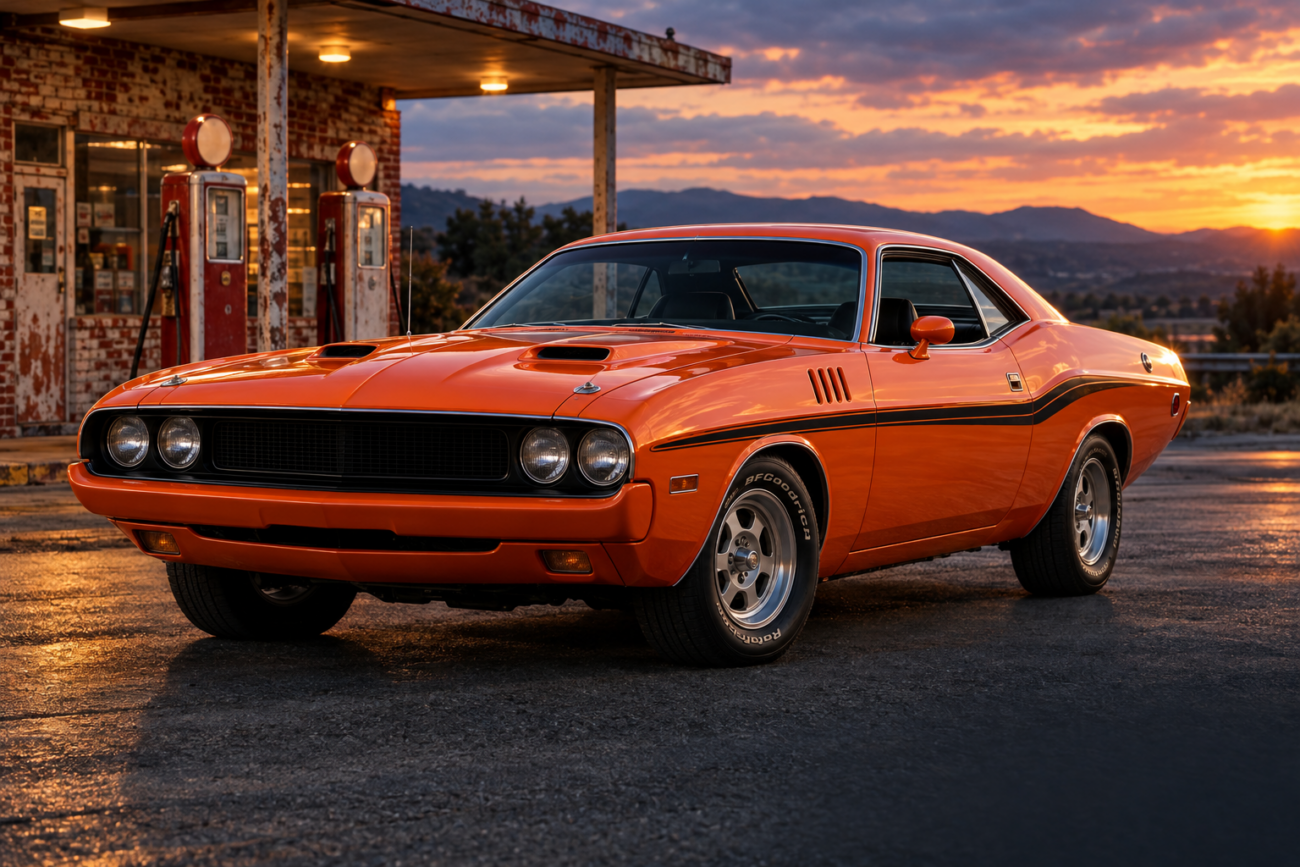
Visually, 1973 is nearly identical to 1972 from most angles, with one federally-mandated change that’s a useful dating cue: the ’73 Challenger actually looked very much like the previous year’s model, although the bumpers were beefed up, and Dodge also promised “Extra Care in Engineering” and a “Torsion Quiet Ride,” which meant fitting rubber blocks to cut road noise. That heavier front bumper is the first step toward the 5-mph bumper standards that would fully hit the car in 1974.
Trims: Base Challenger and the Rallye Package
The Dodge Challenger lineup was consolidated to two trim levels for 1973, with a period brochure stating there were “two ways to assert your personality.” There’s no SE, no R/T, no T/A for this year — just the base car and the Rallye option package (RPO A57). The Rallye Package elevated the standard Challenger with a Performance Hood featuring dual faux scoops, a blacked-out grille, and simulated scoops on the front fenders, all accentuated by distinctive black strobe stripes running towards the rear doors. Inside, the mandated Rallye Instrument Cluster, set against a faux woodgrain insert, included a 7,000 rpm tachometer, 150 mph speedometer, electric clock, analog auxiliary engine gauges, and variable-speed windshield wipers.
Base price for a ’73 Challenger was roughly $3,011 for the base car, with the Rallye appearance package adding around $182 on top. Don’t let the modest hood scoops fool you — on a ’73, both scoops are non-functional; this isn’t a shaker-hood car.
Engines and Drivetrain
Engine choice narrowed hard by 1973. For the 1973 Dodge Challenger with or without the Rallye package, the 318 2-barrel was the standard engine and the 340 4-barrel was an optional engine. There were no other engine options available at the start of the model year. The six-cylinder was dropped entirely: Dodge no longer offered a six-cylinder engine option for Challenger starting in 1973, and with the elimination of the six-cylinder option, the 318 CID V8 became the standard engine in the 1973 Challengers. That’s corroborated independently by Hagerty’s own model description, which notes the slant six engine was gone, and the base engine was now a 150 bhp two-barrel 318 cid V-8. For an extra $181 buyers could get the 240 bhp 340 cid V-8. (One secondary source claims the six-cylinder survived into ’73 — we went with the two independent, stronger sources above that agree it was dropped; flagged for the editor to double-check against an original brochure.)
Partway through the model year, Dodge swapped the venerable 340 for a new big-bore small-block: a new 360 CID V8 was introduced in the middle of the model year, and this was the top engine choice in 1973, though horsepower was only increased by five — from 240 to 245. So a Rallye-package car can legitimately carry either engine depending on build date: all Rallye models were at first outfitted with the 340 engine, and those made in the later part of the production year received the 360 V8. If raw numbers matter to you, note that the 340, with its four-barrel carburetor, provided a satisfying blend of power and responsiveness, and it was the final year the potent 340 engine appeared in the Challenger — so a documented 340-equipped ’73 is the last chance to buy that specific engine in this body.
By 1973, the big-blocks were history. The legendary 426 Hemi and 440 Six Pack engines were no longer available, and the whole powertrain lineup was noticeably milder than the car’s early years — this was a shame considering the options available in 1971, many of which were much more powerful. On the plus side, 1973 is the first model year where Chrysler’s electronic ignition went standard fleet-wide: electronic ignition was standard across the range now with electric chokes, which makes a stock, unmolested ’73 noticeably easier to keep in tune than a points-ignition 1970-72 car. Transmission choices were a 3-speed manual as the base gearbox, with a 3-speed automatic for $81 and a pistol-grip four-speed for $203.
Pre-Purchase Inspection: What to Actually Check
Unibody Rust — The Big One
E-bodies are unibody cars, and rust here isn’t cosmetic — it’s structural. The scale of the modern reproduction-parts industry around this exact car tells you where the money goes: Classic Industries and OER both stock direct-fit replacement torsion bar crossmembers and multiple styles of under rear seat floor pans, trunk floor plugs, partial front floor pans, and rear floor repair panels specifically cut for the 1970-74 Dodge/Plymouth E-body — if it weren’t a chronic, common failure, there wouldn’t be this many SKUs built around it. Walk any prospective ’73 with a flashlight and a magnet and check: the torsion bar crossmember underneath the front floor, the front and rear floor pans (especially under the rear seat and around the trunk), the trunk floor itself, and the frame rails. A real-world example of how bad it gets: on one 1970 Challenger project, the owner said new floors had recently been welded in, including the brackets for seat mounts along with the mount for the console, with the worst remaining spot being on the firewall — and that’s a car already partly repaired. On a less cared-for example, pictures from underneath can show rust far from the devastation you might expect on a nearly 50-year-old muscle car, with the seller admitting a tweaked frame rail isn’t unusual either. Budget a lift inspection, not a driveway walk-around, before you commit.
Fuel Tank and Fuel System
The factory steel fuel tank on these cars is a known weak point across the whole 1970-74 run. Common issues documented by restoration-parts suppliers include rust and pinhole leaks on the bottom and seams (a very common issue), leaking around the sending unit lock ring area, rusted or broken tank straps, failed sending units causing inaccurate fuel gauge readings, and deteriorated filler necks and gaskets. Smell gas in the trunk, or see fuel stains around the tank straps, and budget for a reproduction tank — it’s a well-supported, bolt-in fix, but not a free one.
Authenticity: VIN, Fender Tag, and Broadcast Sheet
Because real Hemi, Six Pack, and T/A E-bodies are worth so much more than a garden-variety 340 or 318 car, verifying what you’re actually buying matters more on this platform than on almost any other American muscle car. From the 1968 model year forward, Chrysler used a 13-character VIN across Chrysler, Dodge, and Plymouth, and on a Challenger the first character will read J, for Dodge Challenger (E-body). The second layer of verification is the fender tag: the E-Body Fender Tag is what E-Body enthusiasts dream about — a small metal tag with a bunch of embossed numbers and letters attached to the car that lists the vehicle’s original VIN, scheduled build date, body color, engine, transmission, and other important options.
Treat a clean, unweathered fender tag with suspicion, not relief. As one long-time E-body owner put it when helping someone sort out a questionable car: reproduction fender tags are available, so the broadcast sheet is the most desirable documentation, and if the fender tag looks a lot cleaner or newer than the rest of the car, that’s a red flag. Also confirm that if the car does not have a fender tag or broadcast sheet, that will significantly reduce the value — missing documentation isn’t just an inconvenience on these cars, it’s a real dollar figure at resale. For a 1973 specifically, the Rallye package code to look for on the tag is A57; if a seller is representing a car as something more exotic, cross-check the specific option codes against the VIN and don’t take a verbal claim at face value.
Recalls and Safety Campaigns
We were not able to confirm any 1973 Challenger-specific NHTSA recall campaigns through currently searchable recall databases — those databases are overwhelmingly populated with records for the modern 2008-and-later Challenger, and period 1970s recall records for this specific car are sparse or not well-digitized online. That doesn’t mean none exist; it means a buyer should run the specific VIN through NHTSA’s VIN lookup and, ideally, cross-check with a Mopar-specific club or marque specialist who may have period service bulletin knowledge the general databases don’t surface. Don’t take “no recalls found” online as a guarantee — verify it yourself before purchase.
What It’s Worth: Current Market
Prices on 1973 Challengers vary enormously depending on engine, documentation, and condition, and this is a market where the gap between a rough driver and a documented, numbers-matching 340 Rallye is huge. Per Hagerty’s own valuation data: a numbers-matching, base 318-powered 1973 Challenger in number-3, or Good, condition currently prices out at roughly $21,900, while the rarer factory 340-equipped version of the same year and condition tier is valued closer to $23,600. But that’s just the baseline — Hagerty’s broader tracking of 1973 Challenger sales over the past three years shows results as low as $3,638 for rough, heavily deviated cars and as high as $242,000 for the best-documented examples, with the most recent public sale landing at $31,000.
Real recent auction results back up that spread. A documented 340/4-barrel car in Hemi Orange sold for $28,620 in late 2025; a Mecum-sold 340 car finished in Panther Pink brought $60,500 in December 2024; a base 318 car in Yellow with a 2-barrel carb made $25,920 at a GAA Classic Cars sale in mid-2024; and a very low-mile (183 miles indicated, “too many to count” flagged) 318 “Custom” example sold for a striking $70,620, underlining just how much a documented, ultra-low-mile survivor can outrun the “typical” numbers above. On the modified/restomod side of the market, a yellow 1973 Challenger built up in Rallye and R/T-style trim, now running a 340 V8 swap, was drawing bids at $22,500 across 16 bids with a few days still left on the clock on Hagerty’s marketplace — a useful real-world anchor for what a nicely-finished, non-numbers-matching driver actually trades for.
Practical takeaway: budget roughly $20,000-$30,000 for a solid, numbers-matching driver-quality 318 or 340 Rallye, $40,000-$60,000+ for a well-documented, strong-condition 340 car or a tastefully built resto-mod, and six figures for the rare, fully-documented, low-mile originals. Treat every number here as a snapshot — this market moves, so get a current Hagerty Price Guide pull and recent comps before you negotiate.
Running Costs and Ownership Reality
This is a 50-plus-year-old unibody car with a carbureted small-block, drum or disc/drum brakes, and a suspension built around torsion bars and leaf springs — simple by modern standards, but everything is now a “classic car parts” purchase rather than a parts-store run. Expect to budget for: fuel tank and sending unit replacement if it hasn’t already been done, floor pan and crossmember repair if rust has taken hold, carburetor rebuilds and ignition tuning (easier than a points car thanks to the standard electronic ignition, but still a skill most daily-driver mechanics won’t have), and brake system overhaul parts that are often reproduction rather than NOS. Insurance through an agreed-value classic car policy is the norm rather than standard auto insurance, and storage/garage space matters — these aren’t cars that tolerate being left outside through a hard winter, for the same unibody-rust reasons covered above.
Years, Trims, and Cars to Be Careful With
- Cars without a fender tag or broadcast sheet: as noted above, missing documentation meaningfully reduces both value and your ability to verify what the car actually is from the factory.
- “Rallye” or “R/T-style” cars that aren’t verified by VIN and fender tag: the Rallye look (hood scoops, stripes, blackout grille) can be — and regularly is — replicated on a plain base car. Confirm the A57 Rallye code on the tag, not just the visual kit.
- Any car represented as a factory 440 or Hemi 1973 Challenger: those engines were not factory-available in 1973 at all. A 1973 car with a big-block under the hood is, by definition, a swap — which may be a perfectly good car, but it is not, and should never be sold as, a factory-original configuration.
- Project cars sold on “solid frame rails” claims alone: as the real-world examples above show, rust can be hiding well past what’s visible without getting the car on a lift and checking the crossmember, floors, and trunk pan directly.
- Cheap “numbers matching” claims with no paperwork: given the price gap between a verified 340 car and an unverified one, get independent confirmation (fender tag, broadcast sheet, or at minimum block-casting-number cross-check) before paying a premium for matching-numbers status.
The Verdict
The 1973 Dodge Challenger isn’t the car to buy if you want a 426 Hemi soundtrack or the wildest High Impact paint colors — that ship sailed by 1972. What it is: the last year a genuinely quick small-block (the 340) was available in this body, wrapped in a shape that’s unmistakably a first-generation E-body, at a price that’s still meaningfully below an early Challenger R/T. Buy on documentation and structural soundness first, cosmetics second — the rust risk and the clone/authenticity risk are the two things that will actually cost you money on this car, not the carburetor or the ignition.
