Why the 2003 350Z Touring 6-Speed Matters
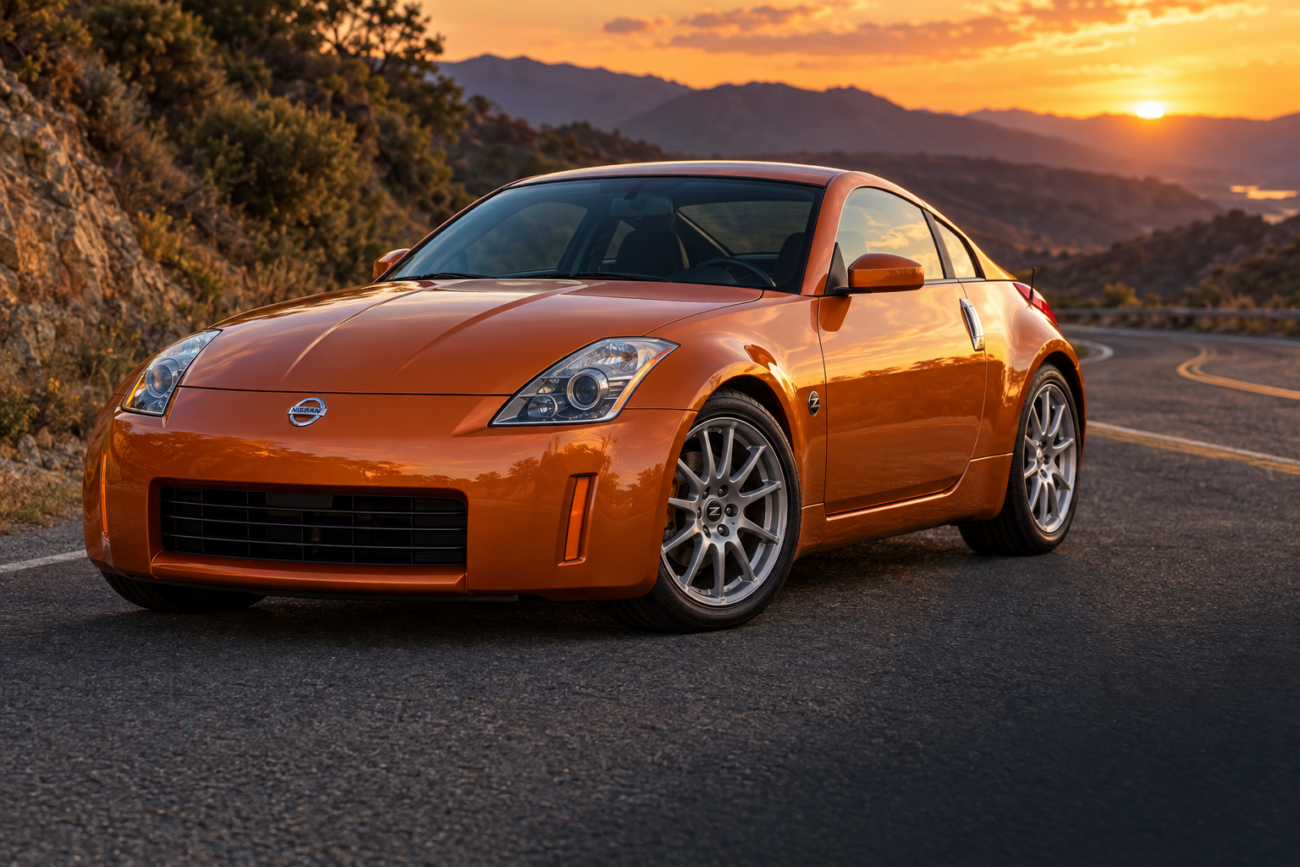
The 2003 Nissan 350Z Touring coupe with the 6-speed manual is the car that relaunched the Z nameplate and did it with the trim that actually makes sense to own today: all the comfort gear of the range-topper, paired with the gearbox enthusiasts actually want. This is the first model year of the Z33 generation, built only as a coupe (the Roadster didn’t arrive until 2004), so it carries both the appeal of being the “original” and the usual first-year caveats that come with any new platform.
Generation & Trim Context
The Z33 generation ran from 2003 to 2009. The 2003 350Z came in five trims: the base model, the Enthusiast, the Touring, the Track, and the Performance. All shared a 3.5-liter V6 engine with 287 horsepower. Within that lineup, the Touring is the most luxurious option, and the Track is the most aggressive — the Touring was built for drivers who wanted the Z’s chassis without giving up daily-driver comforts.
What the Touring Trim Actually Adds
On paper the Touring is a comfort package layered onto the standard Z33 structure, but it’s a meaningful one. The Touring edition of the Nissan 350Z is the high-end model, boasting a leather interior, power seats, heated seats and mirrors, and a Bose sound system. Nissan also fitted front head airbags and front side airbags as part of the Touring’s equipment list, along with HID headlights and a rear limited-slip differential noted on period spec sheets.
Wikipedia’s generation overview corroborates the broader feature set: it had power, leather, heated seats, VDC, a VLSD, xenon headlamps, optional Brembo brakes, 18-inch wheels, and optional GPS Navigation. One enthusiast reference breaks the Touring down further: it adds VDC (manual only), Bose Audio w/ MP3 playback capability, leather seats w/ power and heat, and specifically on the wheel/tire question for a 6-speed car like this one, the same source notes the Touring ran 17″ wheels on AT, 18″ on MT — so a 2003 Touring 6-Speed should be sitting on the larger 18-inch factory wheels, not the automatic’s 17s. If you’re shopping one and it has 17s, that’s a flag to ask whether the wheels have been swapped.
Period pricing data backs up the Touring’s position as the comfort-focused trim: a 2003 350Z Touring 6-speed carried an MSRP around $28,890 versus roughly $26,910 for a base manual coupe, reflecting the leather, Bose, and convenience additions.
The Powertrain: VQ35DE V6 and the 6-Speed
Every 2003 350Z, Touring included, uses Nissan’s 3.5-liter VQ35DE V6, rated at 287 hp, paired here with the 6-speed manual transmission and a rear viscous limited-slip differential. It’s a chain-driven engine — no belt service interval to budget for — but the chain hardware itself becomes the story at higher mileage, which we cover below.
Known Weak Points & What to Check
Tire Wear and Front-End Alignment — the Defining 2003 Complaint
This is the single most corroborated issue specific to the 2003 model year, and it’s worth taking seriously on any 03 you’re inspecting. Owner complaints logged with NHTSA describe rapid, abnormal front tire wear: one owner reported front tires on my 2003 Nissan 350Z are feathering after only 6,000 miles causing a very loud roar in the vehicle cabin below 30 mph, and another complaint flagged that Nissan refuses to let customers know of the tire feathering problem on the 2003-2004 Nissan 350Z. The pattern repeats across many complaints: tires cupping or feathering on the inner or outer edge within as little as 4,000–7,000 miles, traced by owners and some dealers to a front suspension/alignment characteristic rather than a simple tire defect. Cupping and feathering of tires causing road noise, poor traction, and handling was attributed by owners, per forum reports, to suspension geometry affecting alignment. The Center for Auto Safety’s complaint log on this specific model year shows the problem recurring for years after purchase, with one owner reporting the vehicle has had the front tires replaced by the dealer three times, averaging $17,000 to $19,000 per set of tires across repeated incidents (that figure appears to be a complaint-form typo for cost, almost certainly meant as total dollars, not per-set — treat the number skeptically but the recurrence pattern as real). The core takeaway for a buyer: inspect the inner edges of both front tires closely, ask for alignment records, and budget for a four-wheel alignment and possibly a tire replacement regardless of what the tread looks like at a glance — inner-edge wear isn’t always visible from a casual walk-around.
Timing Chain Guides and Tensioner Rattle
The VQ35DE is well regarded generally, but its chain hardware is a known wear item as mileage climbs. Independent engine-focused sources describe the same symptom: a chain-guide/tensioner rattle at cold start on higher-mileage engines, and warn that ignore it long enough and the chain hardware can fail. A separate buyer’s guide focused specifically on the 350Z confirms the same advice for a pre-purchase check: listen for timing chain rattle on startup — excessive noise indicates chain stretch or tensioner failure. A third source covering the whole Z33 generation adds useful detail: the VQ35DE’s timing chain guides and tensioners wear ahead of schedule across 2003-2006 cars, rattling on cold start, most pronounced in the first few seconds before oil pressure builds, though it also notes Nissan never issued a recall for it. Listen to any candidate car on a genuinely cold start — not after it’s been idling in a lot for ten minutes — before you commit.
Oil Consumption
Budget for checking the dipstick more often than you would on a modern car. Oil consumption is listed as a top VQ35DE issue by engine specialists, and a Z33-specific buyer’s guide repeats the same advice from owner forums: checking the dipstick every 1,000 to 2,000 miles is common advice in Rev-Up ownership threads, with owners reporting some engines burn oil fast enough that some were replaced under Nissan’s factory warranty. On a used-car inspection, ask for maintenance records showing oil top-ups between changes, and don’t accept “a quart every few thousand miles is normal for these” from a seller without documentation.
Clutch Master Cylinder “Sticky Pedal”
On 6-speed DE-era cars specifically (which includes this 2003), watch for a clutch pedal that doesn’t return cleanly after a shift. A clutch master cylinder develops a “sticky pedal”: the pedal doesn’t return cleanly after a shift, especially in cold weather, because an internal seal wears. The same source estimates a DE-era master cylinder is a $150-$300 fix — worth confirming with a current quote, but a useful ballpark for negotiating.
Manual Transmission Synchros and Rear Diff Bushings
Because this car is a manual, pay specific attention to the gearbox under load. Manual transmissions develop issues in 5th and 6th gear with hard shifting. Synchros wear out and cause grinding or pop-out under load. The same source flags the differential mounts as a related wear item: the rear differential bushings also go soft over time, causing clunking on deceleration when they’re shot. On a test drive, run the car hard enough to load 5th and 6th gear under acceleration and deceleration, and listen for clunks when you lift off the throttle.
Interior Rattles and Minor Squeaks
Don’t expect a silent cabin. Interior squeaks and rattles are a frequent enough complaint on forums that most owners stop mentioning them after the first year of ownership. One Center for Auto Safety complaint even described a secondary rattle created as a side effect of recall warranty work: that problem is fixed, but due to the recall, the dealer created a door rattle that evidently cannot be fixed. None of this is a dealbreaker, but don’t let a few cabin rattles spook you out of an otherwise sound car — and don’t assume a rattle-free cabin means a better-maintained example, either.
Recalls on the 2003 350Z
NHTSA records show two safety recalls that apply to 2003 350Z production, and both are worth checking against your specific car’s build date before you buy.
- Campaign 03V455000 — Engine and Engine Cooling (crank/cam position sensor). On certain passenger vehicles, the circuit board for the crank position sensor or cam position sensor may have an improper solder joint due to solder deformation caused by heat stress accelerated by the existence of flux residue during the soldering process. Dealers will replace the crank position sensors, camshaft position sensors, and in some cases, the variable timing control sensors. This campaign applied to vehicles built between April 1, 2002 and June 30, 2002, so it only affects the earliest-production 2003 cars.
- Campaign 05V555000 — Fuel System, Gasoline (fuel filler hose). On certain passenger and sport utility vehicles, the fuel filler hose may crack and result in fuel leakage from the hose while refueling. Fuel leakage in the presence of an ignition source could result in a fire. Dealers will replace the fuel filler hose. This one covers a much wider production window — vehicles built April 17, 2002 through November 3, 2003 — meaning most 2003 350Z production is in scope.
Run the VIN through NHTSA’s recall lookup before you buy, and ask to see dealer service records confirming both campaigns were completed — fuel filler hose cracks in particular are a real fire risk if left unaddressed on a 20+ year old car.
Pre-Purchase Inspection Checklist
- Cold start the engine yourself (don’t let the seller warm it up first) and listen for timing chain rattle in the first few seconds before oil pressure builds.
- Pull the dipstick and check oil level and condition; ask for records of oil top-ups between changes.
- Inspect the inner edges of both front tires for feathering or cupping, and ask for recent alignment records — this is the signature 2003-model-year complaint.
- Confirm the car rides on the correct 18-inch wheels for a Touring 6-speed, not the smaller 17s fitted to automatic Touring cars.
- Drive it hard enough to load 5th and 6th gear in both acceleration and deceleration; listen for grinding, pop-out, or a clunk from the rear differential area on lift-off.
- Check clutch pedal return after a shift, especially from a cold start — a slow or sticky return points at the clutch master cylinder.
- Check for milky oil or white exhaust smoke (head gasket) and any coolant/oil cross-contamination on the dipstick or cap.
- Verify both 2003 recall campaigns (crank/cam sensor, fuel filler hose) show as completed on a NHTSA VIN lookup and in service records.
- Inspect the door jamb tire placard against the tires actually fitted — confirms nothing unusual (including any non-standard run-flat fitment) has been swapped in.
Values and Running Costs
A 2003 350Z Touring 6-speed originally stickered close to the top of the early Z33 range; period MSRP data puts a manual Touring coupe at roughly $28,890 versus about $26,910 for a base manual coupe, reflecting the leather, Bose, heated seats, and HID lighting. Current used values vary significantly by condition, mileage, and modification history, and this draft does not include a specific current price range — pull live comps from current marketplace listings before publishing a number, since 20+ year old sports car values move with enthusiast interest and condition more than with a simple depreciation curve.
Ongoing ownership costs to budget for beyond routine service: a clutch master cylinder in the $150–$300 range when the pedal starts sticking, a timing chain guide/tensioner service if cold-start rattle is present, four-wheel alignments (potentially more than one, given the documented front-end wear pattern on this model year), and the usual 20-year-old-car items — bushings, mounts, and interior trim rattles.
Verdict
The 2003 350Z Touring 6-speed is the right call if you want the first-year Z33’s raw, unfiltered character — no VQ35HR power bump, no HR-era suspension tweaks, just the original recipe — without giving up leather, Bose, heated seats, and a limited-slip differential. The trade-off is that it’s also the most first-year of first-year cars: the documented front tire wear/alignment complaint is real and specific to 2003–2004 production, both recalls need to be confirmed as completed, and the VQ35DE’s known chain-rattle and oil-consumption tendencies apply in full. None of these are reasons to walk away from a well-documented example — they’re reasons to inspect thoroughly, negotiate on anything unresolved, and buy the service history as much as the car.
