
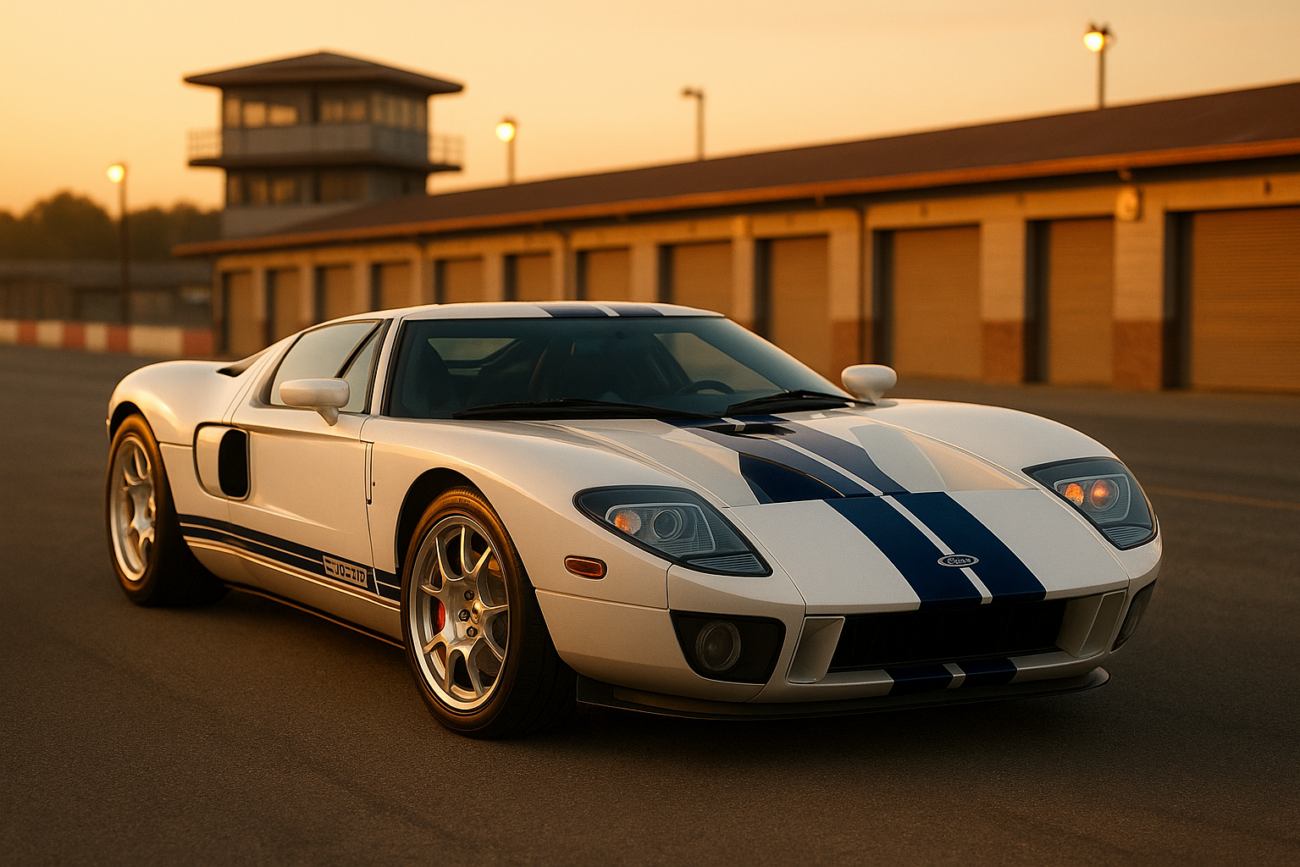
Overview: What the Ford GT Actually Is
The modern Ford GT isn’t a tribute car or a parts-bin special — it’s a mid-engine homage to the 1960s GT40 Le Mans winners, built in tiny numbers for the 2005 and 2006 model years. Production totaled 4,038 units across the 2005–06 run, and the production GT arrived in fall 2004 for the 2005 model year, more than two years after the concept’s 2002 Detroit auto show debut. It was a halo car built to mark Ford’s centennial, and because Ford never secured rights to the “GT40” name, the GT40 name was dropped and the production car was simply badged “GT.”
Mechanically, there’s only one spec to know. Every car used a 5.4-liter supercharged aluminum-block V8 producing 550 hp at 6,500 rpm and 500 lb-ft of torque at 4,500 rpm, sent through a Ricardo 6-speed manual transmission to the rear wheels via a limited-slip differential. That was good for 0–60 mph in 3.3 seconds, an 11.6-second quarter mile at 128 mph, and a 205-mph top speed, with the car weighing in at 3,549 lbs. Ford built the GT’s engine around a purpose-made aluminum block with forged internals, custom camshafts with more lift than the Shelby GT500’s, and an Eaton Lysholm supercharger — a genuinely serious piece of engineering, not a warmed-over Mustang.
2005 vs. 2006: The Differences That Actually Matter
There was no generational redesign in this car’s two-year life, but there are details worth knowing — partly for buying the right spec, partly because they help you spot a car that’s had front-end work. In 2005 the GT had a mesh grille in its nose, but for 2006 it was deleted and replaced with a slatted grille — if a car has the wrong grille for its model year, it may have suffered front-end damage. Ford also made a running change mid-2005: late-2005 and all 2006 cars lost a screen mounted in front of the radiator (deleted for added cooling) and got a slightly altered front bumper.
Pricing moved too. Ford instituted a $10,000 price increase on all GTs built after June 2005, and running changes through the life of the car were otherwise minor: a revised clamshell release using helper springs instead of rubber stops, and a switch from solid tubes to stainless flex hoses for the transaxle’s oil pump. For 2006, the brackets holding the engine oil reservoir to the frame switched from silver to black finish, and Ford deleted a painted clip that had concealed the gap between the roof panel and rear clamshell.
The big visual story for 2006 is the Heritage Edition. Ford introduced the “Heritage Blue Livery” for 2006 — the Gulf Oil-inspired scheme worn by the Le Mans-winning John Wyer Automotive GT40s of 1968–69 — as a $13,000 option that found 343 buyers, and added a new Tungsten Grey color that proved popular, fitted to 541 cars. Quick Silver Metallic, offered in 2005, was dropped for 2006. Among first-gen GTs, the Heritage car is now generally regarded as the best-looking of the series, despite being seen as a bit much by some buyers when new.
Factory Options — There Were Only Four
Ford kept the options list deliberately short. The factory offered just four options: painted racing stripes, BBS forged wheels, painted brake calipers, and the McIntosh audio system — no sport packages, no tech bundles, no dealer-installed add-on menu. Original pricing: McIntosh stereo with a subwoofer between the seats ran $4,000, BBS forged wheels $4,000, a painted center racing stripe $5,400, red or grey brake calipers $750, and the rare side-stripe delete was a no-cost option. These options still move resale value today — auction data suggests a roughly $4,000 premium for BBS wheels, $3,000 for factory stripes, $2,500 for the McIntosh stereo, and $900 for painted calipers. A matching-numbers car with all four boxes ticked, and ideally still wearing its factory plastic sill protectors, commands the strongest money.
Known Issues and Weak Points
This is not a fragile car — the GT is widely described by specialists as mechanically robust for its power level — but a handful of issues come up consistently across owner forums, specialist buying guides, and consumer-complaint aggregators. Treat anything that only appears in one place as a lead; here’s what’s corroborated across multiple sources.
Engine
Early crankshaft seal leak (2005, early production): Early production cars used a “speedy sleeve” to stop a crankshaft leak, and no further problems have been reported once that fix was applied. Separately, early engines could suffer a rear main seal oil leak traced to incorrectly machined crankshafts — ask for service records confirming this was addressed under the original warranty, since a rushed development cycle meant some early production cars were plagued by faults that should have been corrected under warranty, and it’s worth checking service records to confirm this was done.
Dry-sump oil system: Make sure the dry-sump oiling system pump belt has been serviced per the owner’s manual’s required interval — this is a simple maintenance item, but a neglected one can cause expensive problems down the line.
Cold-gearbox stiffness is normal, grinding is not: Gear changes between first and second tend to be stiff and tight until the transmission fluid has warmed through — that’s characteristic of the car, but excessive grinding or persistent stiffness points to a real issue needing attention. Likewise allow time for the gearbox to heat up before driving aggressively, as shifting can be difficult until it does.
Stalling complaints: One consumer-complaint aggregator notes reports of cars dying unexpectedly while in motion, though this stalling problem has mostly been reported on 2005 and 2006 models with over 100,000 miles on the odometer — relevant context, since very few GTs have covered that kind of mileage. Get any car with high miles thoroughly scoped before buying.
Supercharger: One source flags that the supercharger needing a rebuild at higher mileages has been reported, though this is less common with regular maintenance — we could only corroborate this with a single source, so treat it as a lead to investigate on any high-mile example rather than an established characteristic fault.
Clutch and Driveline
Some owners have experienced issues with the original clutch wearing prematurely, especially under aggressive driving. One specialist buyer’s guide prices clutch and synchro wear — symptoms include slip, judder, or crunch on shift, with a typical repair cost in the $3,000–$6,500 range, confirmed by road test (get a human quote before relying on this figure — costs vary by shop and region). Separately, failing gearbox shaft flange bolts affected some cars but should have been rectified by dealers — check service records to confirm.
Suspension and Steering — the one real recall-grade fault
The GT’s single safety-significant mechanical recall concerns the control arms. Ford recalled certain early 2005 GT vehicles for a defect in the front and rear upper and lower control arms after one car suffered a control arm failure; the fix replaced the cast aluminum originals with a set of billet aluminum wishbones on affected early-build cars. Confirm via service records or a VIN check that any pre-fix car received this remedy.
Beyond the recall, power steering and engine coolant hose leaks affected some models but were easily rectified with modified hoses, and some owners noted steering column rattles that were mostly repaired under warranty. Premature tie rod end wear has also been observed, which can affect steering responsiveness, and axle bolt failures affected some cars as well — all worth checking on a pre-purchase inspection, particularly on a car with any track history.
Interior, Electrical, and Body
Magnesium console corrosion: this is the GT’s best-known cosmetic failure point, corroborated across multiple independent sources. The magnesium alloy central tunnel can corrode, which causes the paint on it to crack and flake, and the only real fix is to strip it completely and repaint — with no guarantee corrosion won’t resurface under the new paint.
Gauges: The Autometer-sourced instruments have a reputation for failing after just a few years in service — check every gauge carefully, since replacements must be sourced directly from Autometer (though aftermarket alternatives exist from Speedhut). Separately, instrument cluster failures leading to inaccurate or non-functional gauge readings have also been reported.
Paint peeling (hood, mostly 2006): Some 2006 GTs have reported paint peeling, particularly on body panels, and a separate source narrows this to the hood specifically, noting the complaint was concentrated on 2005 and 2006 cars and one owner was told the fix was only covered under the original 3-year warranty.
Floor mats and weatherstripping: Floor mats are prone to degrading and often require replacement, and weather stripping around doors and windows can deteriorate over time, risking water ingress.
Fuel system: The fuel tank can expand, reportedly due to ethanol content in modern gasoline, which can cause fuel gauge inaccuracy and other fuel system problems, and separately some owners report difficulties with refueling, often traced to a faulty fuel filler neck design.
Air conditioning: The AC system is another area of concern, with reports of compressor failures and refrigerant leaks.
Wheels: Factory wheels — including the optional BBS pieces — are prone to damage and are difficult to repair, so curb rash or cracking should factor into your offer.
Tires: this is a universal checkpoint regardless of year. Dry-rotted tires are commonplace on low-mile cars, and because the GT has no traction control, tire condition is crucial to how the car actually drives — if the rubber is 7+ years old, factor replacement into your offer.
Recalls — What’s Actually on File
Aggregators don’t agree on a single recall count (anywhere from 4 to 11 depending on how campaigns and model years are bucketed), so verify any specific car’s status directly on NHTSA.gov by VIN before buying. Here’s what’s consistently documented:
- Suspension control arm (NHTSA 04V604000, 2004): Ford recalled certain 2005 GT vehicles for a defect in the front and rear upper and lower control arms; some units had casting imperfections, remedied with the billet aluminum arms described above.
- Takata airbag inflators — multiple campaigns, 2014 through 2021: Ford recalled certain 2005–2008 Mustang and 2005–2006 GT vehicles because, upon deployment of the driver-side frontal airbag, excessive internal pressure may cause the inflator to rupture. This was expanded multiple times as Takata’s broader inflator crisis unfolded; by 2016 Ford was running a passenger airbag inflator replacement campaign specifically for 2005–2006 GT vehicles, and a further 2021 notice covered airbag module inspection and replacement for vehicles that may have been serviced with a recalled Takata inflator as a “replacement” part in error.
- Active Do-Not-Drive advisory: One recall-tracking source states plainly that Ford has an active “do-not-drive” advisory for the remaining unrepaired 2005–2006 GTs equipped with non-desiccated Takata ammonium nitrate inflators, since the defect involves propellant degradation after prolonged exposure to high humidity and high-temperature cycling. This is the single most important pre-purchase check on any first-gen GT — confirm via NHTSA.gov or a Ford dealer that both the driver and passenger airbag recalls are completed before you drive, or even move, any car you’re considering.
Pre-Purchase Inspection Checklist
General advice from specialist buying guides converges on a few consistent themes: a GT pre-purchase inspection should proceed much like any other collector car — verify every feature, button, and switch works as intended — plus these GT-specific items:
- Confirm the control-arm recall and all Takata airbag recalls are completed, via VIN lookup, not just verbal assurance.
- Check the magnesium center console for corrosion/paint cracking around the console and lower door cards.
- Test every gauge on the Autometer instrument cluster for drift or failure.
- Inspect tire age (date code) regardless of tread depth — dry rot is common on low-mile, long-stored cars.
- Check for grinding or persistent notchiness in 1st/2nd gear beyond normal cold-gearbox stiffness.
- Road-test for clutch slip, judder, or shudder on engagement.
- Inspect BBS wheels (if fitted) closely for curb damage or cracks — they’re costly and difficult to repair.
- Check for front-end damage inconsistent with the car’s model-year grille (mesh for 2005, slatted for 2006).
- Review service records for the dry-sump pump belt interval and any documented throttle-body service campaign work.
- Have a specialist perform a leak-down/compression test and a long enough road test to expose heat-soak-related faults after extended driving.
- Use a paint-depth gauge and a specialist familiar with the model’s factory panel gaps and finish standards to check for refinished panels or concealed accident/fire damage, which severely affects collector value.
Servicing and Running Costs
Servicing needs to be done yearly or every 5,000 miles, and the good news is the drivetrain itself is comparatively low-drama for the power on offer: the 32-valve DOHC 5.4-liter V8’s cams are chain-driven, so there’s no finicky timing belt to worry about. That said, this isn’t a cheap car to maintain at a GT specialist — one UK buying guide put routine annual servicing around £2,000 (figure needs a current US-dollar equivalent check), and the clutch/synchro and throttle-body items above run into the low thousands when they do come due. Budget accordingly, and don’t skip service history as a negotiating factor — deferred maintenance on a car of this class is almost always more expensive than buying a better-sorted example in the first place.
Values and Market Trajectory
The GT has had one of the more dramatic value trajectories of any modern-era supercar. When the first-generation Ford GT debuted in 2005, it carried an MSRP of around $150,000, and demand far outstripped supply even then, with dealers tacking on hefty markups. With only a little over 4,000 units produced, the GT’s rarity combined with its performance and retro design made it a collector’s darling almost overnight.
Current market data (snapshot, will move): the 2005 Ford GT’s highest recorded auction sale was $671,000, with 2025 sales showing a median of $445,500, a high of $605,000, and a low of $390,000 across eight recorded sales with a 100% sell-through rate. The 2006 model, which includes the rarer Heritage Edition, has run a bit hotter: the 2006 GT’s highest recorded auction sale was $1,375,000, with 2025 sales showing a median of $612,500 and a high of $1,001,000 — almost certainly a well-optioned Heritage car skewing that top end. For context on broad positioning, one 2026 pricing guide puts the first-generation (2005–2006) GT’s typical secondary-market range at $300,000–$600,000, with rare-spec or low-mile cars reaching $600,000–$800,000-plus.
Zooming out, a clean, low-mileage 2005 GT recently crossed the block for $550,000, which underlines how far the car has moved from its original sticker. Expect continued volatility year to
