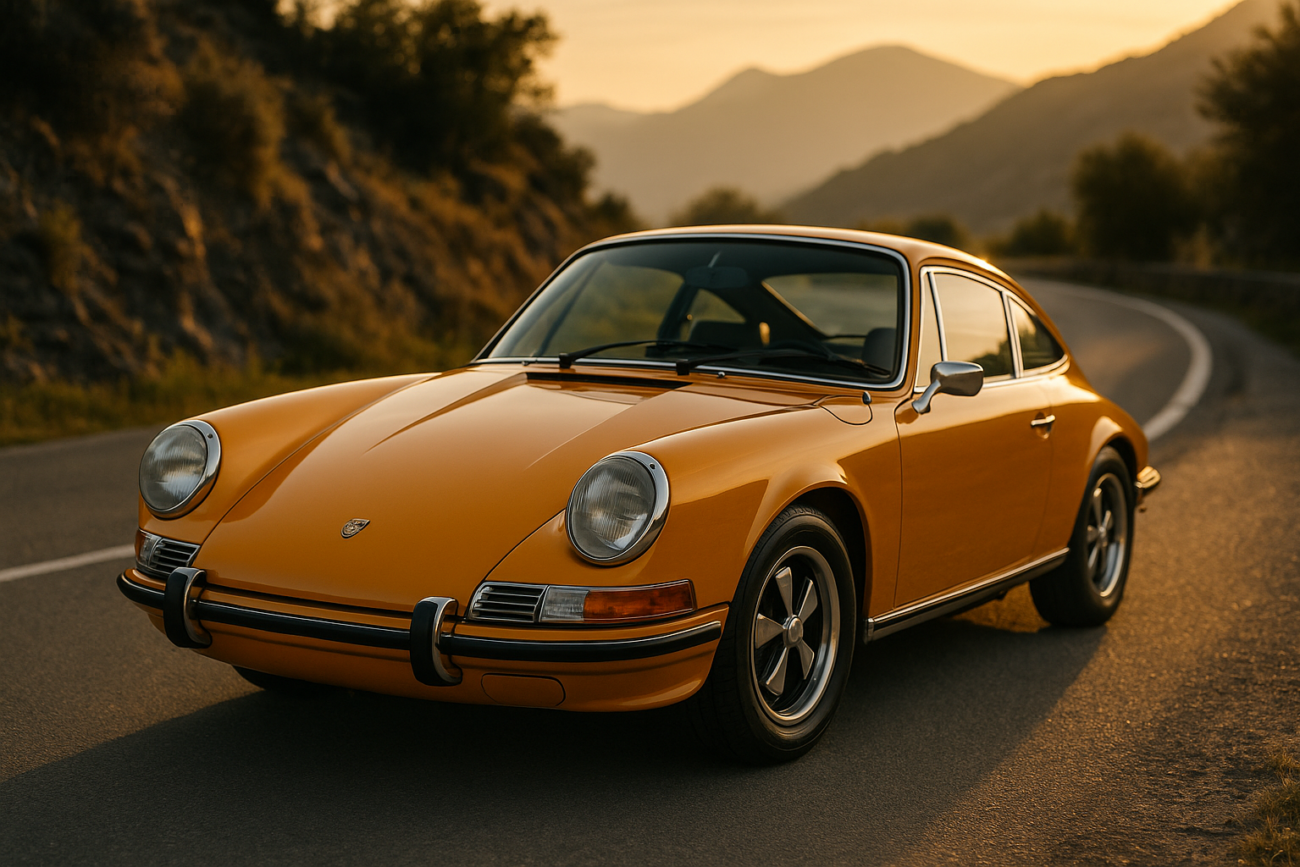
The 911T was Porsche’s entry point into the 911 range from day one, and the 1970 car sits at a genuinely significant hinge point in early-911 history. The first T models came onto the market in late 1968 as a 2-liter, followed by the 2.2-liter. 1970 is the first model year of that larger, torquier engine, and it arrives on a chassis that had already been improved with the longer wheelbase and Fuchs alloy wheels rolled out just before it. The 911T continued as the entry level 911 for the 1970 and 1971 model years, sitting below the 2.2L 911 E and the 2.2 L 911 S, and featured all the upgrades that came with production updates including longer wheelbase and Fuchs alloy wheels. It was offered as both a Coupe and a Targa.
For a buyer today, that combination — the least-stressed, carbureted six, the improved long-wheelbase chassis, and chrome-bumper “small” 911 looks before the 5-mph bumpers of 1974 — is exactly why the early-70s 911T has become one of the more sought-after ways into air-cooled 911 ownership.
Engine, Drivetrain, and What Changed for 1970
The headline mechanical news for 1970 was the jump in displacement. In 1970 came the larger and more potent 2.2-litre engine — more power, more torque and a decent improvement in performance were the result. The Flat 6 engine got to its 2.2 liter displacement thanks to an increase in bore from 80mm to 84mm, with stroke unchanged at 66mm, for a total displacement of 2195cc. Porsche didn’t stop at boring it out: other enhancements to the engine included bigger valves, new head gaskets and more cooling fins on the cylinder barrels.
Unlike its E and S siblings, the T kept things simple and cheap to service. The 911T (Type 911/03, or 911/06 with Sportomatic, 911/07 for US-spec) featured Zenith carburetors and was rated at 125 hp, while the 911E and 911S used mechanical fuel injection. Sources differ slightly on the exact output — one puts European-spec at 120 hp DIN, another at 123 bhp/125 PS — so treat the figure as “roughly 120-125 hp” until you’ve confirmed the specific market-spec sheet for the car in front of you (US-spec cars were tuned slightly differently for emissions from this era onward). Peak torque is quoted around 130 lb-ft at 4,200 rpm, and top speed is in the 124 mph region with a 0-60 time in the low-to-mid 9-second range on period tests — modest by modern standards, but the T was never the point-and-squirt model; it’s the lightest, simplest, and most mechanically honest of the three 1970 trims.
Transmission choices were a 4-speed or optional 5-speed manual, plus the semi-automatic Sportomatic (identified by the 911/06 engine code). Sportomatic cars are meaningfully less desirable to enthusiasts today and it shows in resale values — if you want a manual, confirm the gearbox type before you go look at a car, since Sportomatic-to-manual conversions are common and not always disclosed.
Chassis Notes: 1970 vs. the Surrounding Years
The 1970 and 1971 cars sit right at the end of the true “small bumper” long-hood era before more significant regulatory changes hit in 1972-73. Worth flagging for buyers: the following-year 1971 cars reportedly received a zinc coating applied to the bodyshell along with piston-cooling oil squirters and fuel-injection refinements — but this is a limited, partial anti-corrosion measure, not the full hot-dip galvanization process Porsche is famous for, which didn’t arrive until 1976. Don’t let a seller tell you a 1970 or 1971 car is “galvanized” in the way a 1976-and-later car is; it isn’t, and rust protection on these cars is minimal by modern standards regardless of what year-specific tweaks were applied.
The Big Money Items: Rust, the Timing Chain Tensioners, and Engine Rebuilds
These points are well established across the early-911 community and restoration trade, though they weren’t independently re-confirmed with fresh sourcing in this research pass (see editor’s note) — treat the specifics below as a starting checklist, not gospel, and have a specialist verify current guidance before this goes live:
- Rust. Long-hood 911s from this era are unibody cars with minimal factory corrosion protection, and 55 years of road salt, condensation, and bad prior repairs take their toll. The classic problem zones to inspect closely are the front and rear floor pans, the battery tray and surrounding inner fender area, the torsion tube/longitudinal member under the floor, the sills (rocker panels), the front luggage compartment (particularly the corners and spare-wheel well), the base of the windshield/A-pillars, and the headlight buckets. A car that looks straight from three feet away can still hide serious floor and sill rot under undercoating or fresh paint — a lift inspection is non-negotiable.
- Timing chain tensioners. Early 911 flat-sixes use chains to drive the camshafts, and the original tensioner design on the earliest cars is a known weak point that, if it fails, allows the chain to jump and can cause serious valve-to-piston damage. Confirm with a specialist whether the specific tensioner design fitted to a 1970 2.2-liter engine is the earlier or later revision, and budget for the tensioner upgrade if it hasn’t already been done — this is one of the first things a pre-purchase inspection (PPI) should check, listening for chain rattle on cold start.
- Engine condition generally. These are low-volume, high-value engines to rebuild today — parts and machine work for a numbers-matching 2.2 are not cheap, and a “runs and drives” car can still be masking bore wear, weak head studs, or oil leaks (leaks are near-universal and mostly cosmetic/maintenance issues rather than deal-breakers on their own). A recent example service history for one 1970 911T we reviewed included a full engine and transmission overhaul at under 42,000 km, which underlines how these cars need periodic major mechanical attention even at modest mileage — don’t assume low miles means low risk.
Recalls, Titles, and Documentation
No verified NHTSA or Porsche AG recall records for this vehicle were confirmed in this research pass — for a car this old, formal recall campaigns are largely irrelevant to the buying decision anyway, but a title history and VIN check is still worthwhile to rule out salvage history, non-matching engine/chassis number swaps, or grey-market/US-spec conversions. Matching numbers (engine number correlating to the chassis) matter enormously to value on these cars — verify it yourself against the data plate and don’t take a seller’s word for it.
Pre-Purchase Inspection Checklist
- Full lift inspection: floor pans, sills, torsion tube, battery tray, front trunk floor and corners, headlight buckets.
- Cold start listen for chain tensioner rattle; ask when the tensioners were last serviced/upgraded.
- Verify engine and chassis numbers match the data plate and any accompanying Porsche Certificate of Authenticity (COA) if available.
- Confirm transmission type (manual vs. Sportomatic) and check for smooth, notch-free shifting.
- Carburetor tune on the Zenith units: rough idle, hesitation, or an inability to hold a clean idle often means the carbs need a rebuild rather than a simple adjustment.
- Full paperwork trail — service invoices, prior PPIs, ownership history — a car with a documented chain like regular service, a major service, and a full engine and transmission overhaul on record is worth a real premium over one with no history at all.
- Check for accident repair evidence: panel gaps, overspray, mismatched seam sealer.
Values and Market Trajectory
Values for the 1970-71 2.2-liter 911T have risen sharply along with the rest of the air-cooled 911 market over the past decade, but the spread between a rough project and a documented, matching-numbers example is enormous. Auction data for the closely related 2.2-liter T generation shows just how wide that spread is: the highest recorded sale was $171,911 for a 1971 Porsche 911T Coupe, while the lowest recorded sale was $1,400 for a 1970 Porsche 911T Coupe by Karmann — the latter almost certainly a parts car, shell, or non-running project rather than anything representative of a usable car. Treat both figures as bookends, not a “normal” range; get a current Hagerty or recent public auction comp before quoting a price band to a reader, since this market moves quickly and regionally.
Heavily modified or restomodded examples occupy their own market entirely and shouldn’t be used to benchmark a stock car’s value — one European listing we found priced a highly modified, RSR-spec 1970 911T conversion at 138,000 euros with 76,867 kilometers on the odometer, but that car had a built engine, upgraded suspension, and a strengthened gearbox rather than anything close to factory spec.
Who Should Buy One
The 1970 911T Coupe is the honest, mechanically simple way into long-hood 911 ownership: carburetors instead of finicky mechanical fuel injection, a manual gearbox that doesn’t need Sportomatic-specific expertise to maintain, and the improved long-wheelbase chassis without the weight and bumper changes of later cars. It’s not the fastest early 911 — that’s the S — but it’s arguably the most usable and the most forgiving to own if you’re doing your own maintenance. Buy on documentation and rust condition first, matching numbers second, and horsepower dead last.
